

A neighbourhood networking platform is a digital space where residents, volunteers, and local businesses connect around a shared geography rather than shared interests. Thehivewindsor is a live example built for Windsor-Essex: ad-free, locally verified, and designed so you never have to bounce between five apps to find out what's happening on your street. Platforms like it can run on open federation protocols such as ActivityPub, and research from the Centre for Ageing Better shows they can do real public good beyond just convenience.
Here's what a well-built neighbourhood platform actually delivers:
- Trusted local membership through address or phone verification
- Hyperlocal feeds that surface nearby posts before broader area content
- Ad-free business discovery ranked by community reviews, not ad spend
- Event coordination and group channels organized by street or district
- Volunteer and mutual-aid tools that connect people who need help with people who can give it
Table of Contents
- How neighbourhood networking platforms work: the core components
- Community vs. network: why the gate model changes everything
- Federation vs. walled gardens: what the technical choice actually means
- Privacy, data ownership, and moderation: the trust layer
- How neighbourhood platforms support local health and resilience
- What ad-free discovery looks like for local businesses
- How to join or start a neighbourhood networking platform
- Common pitfalls that cause user churn
- Key Takeaways
- A local perspective on why this matters for Windsor-Essex
- Thehivewindsor: Windsor-Essex's ad-free local platform
- Sources and further reading
How neighbourhood networking platforms work: the core components
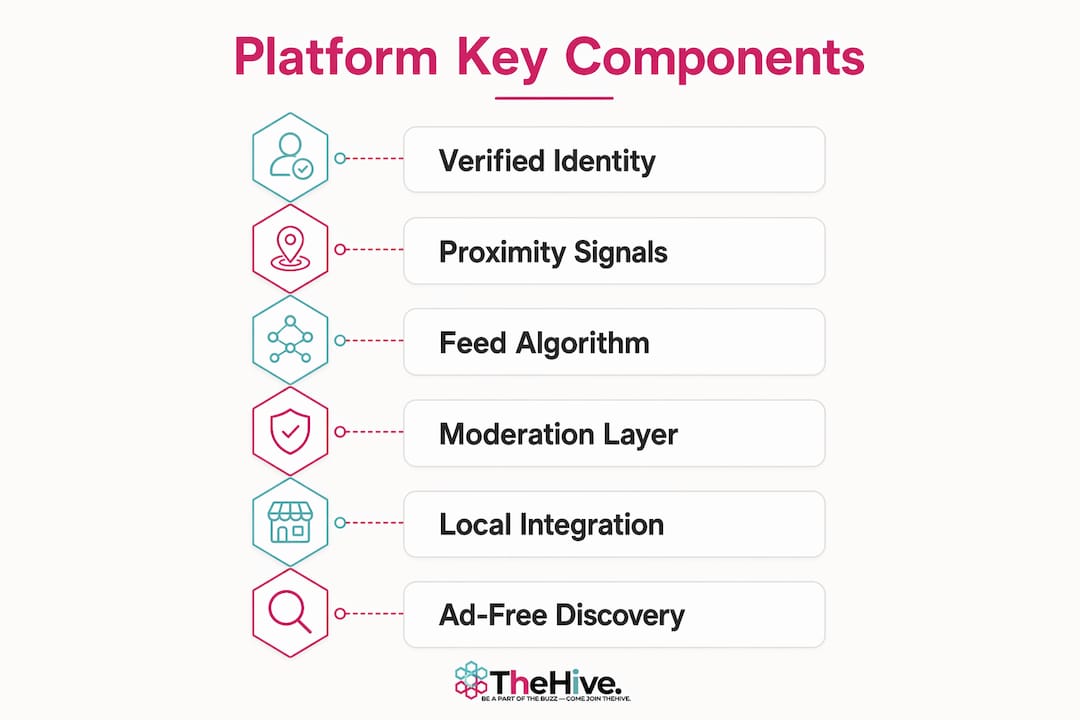
Every platform in this category is built from six key building blocks. What separates good ones from ghost towns is how tightly those pieces interlock.
| Component | Primary benefit | Local example |
|---|---|---|
| Member profiles | Establishes verified identity and proximity | A LaSalle resident confirms their address and appears in the Sandwich West feed |
| Neighbourhood feeds | Surfaces timely, nearby content | A lost dog post reaches only the relevant three-block radius |
| Groups and channels | Organizes discussion by topic or geography | A Tecumseh parents' group shares school-closure alerts |
| 1:1 messaging | Enables private, trusted exchange | A homeowner contacts a verified local plumber directly |
| Events calendar | Drives offline connection | A Walkerville block party gets 40 RSVPs through the platform |
| Business profiles and reviews | Powers ad-free local discovery | A 40-year-old Windsor bakery ranks above a chain because neighbors love it |
The components work together through proximity signals. Verification ties a profile to a real address; the feed algorithm uses that address to weight nearby content higher; reviews on business profiles feed back into the same local trust graph. Nothing in that chain requires paid placement.

Pro Tip: Design your feed to prioritize posts from the two or three streets immediately surrounding a member before widening to the broader neighborhood. That tight radius builds accountability fast because everyone knows everyone.
Community vs. network: why the gate model changes everything
These two words get used interchangeably, but they describe fundamentally different things. A community is open, built around belonging, and scales by adding members. A network requires an explicit gate — an application, an invitation, a fee, or a vetting step — and trades raw volume for relationship density.
In Windsor-Essex terms: a community might be an open Facebook group for the whole city. A network is a verified-address platform where you know every member actually lives nearby.
Gate types and their trade-offs:
- Address verification (postcard code, phone, billing address): highest trust, some onboarding friction, best for residential platforms
- Invitation-only: fast trust, slow growth, works well for professional or trade-specific layers
- Paid tiers: filters for commitment, risks excluding lower-income members, suits premium business listings
- Open enrollment: fastest growth, lowest average engagement, high churn risk
Pro Tip: Start open to build critical mass, then add a gated inner layer — a verified-resident group or a vetted-business directory — once you have 150+ active members. The inner layer becomes the high-value core that keeps the broader community anchored.
Federation vs. walled gardens: what the technical choice actually means
Under the hood, every neighbourhood platform makes one foundational decision: does it talk to other platforms, or does it keep everything inside its own walls?
Federation means independent servers share data using an open protocol. ActivityPub, the W3C standard that powers Mastodon and others, lets members on one installation follow, like, and interact with members on a completely separate server. Your Windsor-Essex profile could, in theory, interact with a Detroit neighbourhood platform running the same protocol.
A walled garden keeps all data, identity, and content inside one controlled environment. Facebook Groups is the obvious example.
Federation is not a purely technical decision. It is a product decision about who owns the relationship with your members and what happens to their data if the platform shuts down. A federated platform lets members take their identity and connections elsewhere. A walled garden does not.
Trade-offs at a glance:
- Federation pros: data portability, interoperability, no single point of failure, aligns with open-web values
- Federation cons: heavier moderation load (you must handle remote content), more complex infrastructure, harder to enforce local-only rules
- Walled garden pros: full control over moderation, simpler UX, faster to build and iterate
- Walled garden cons: member lock-in, data loss risk if the platform closes, no interoperability
For a hyperlocal platform like Thehivewindsor, a walled garden with clearly published data-export options often makes more practical sense than full federation, because local-first moderation is easier to enforce.
Privacy, data ownership, and moderation: the trust layer
Verification is the foundation. Multi-option address verification — postcard codes, phone confirmation, or billing address matching — gives platforms flexibility without sacrificing accuracy. Offering only one method kills conversion; offering three keeps onboarding practical for most residents.
Data ownership questions every member should ask before joining:
- Can I export my posts, connections, and reviews?
- How long does the platform retain my data after I leave?
- Is my address shared with businesses, or kept private?
- Who reviews moderation decisions, and is there an appeals process?
On the moderation side, manual review alone does not scale. Practitioners target automated detection of roughly 95% of violations, with human moderators handling the remainder for context and nuance. The moderation flow looks like this: automated filter catches a post → rule-based or AI sentiment check → escalation to a human moderator if flagged → published decision log. Trust signals to look for in any platform's UI include verified badges on profiles, a transparent community guidelines page, and a visible appeals path.
How neighbourhood platforms support local health and resilience
The Centre for Ageing Better's Neighbourhood Networks model frames this clearly: neighbourhood networks act as secondary prevention, offering social contact, volunteer befriending, and signposting to services that can delay decline in older residents. The Leeds model combines structured activities with peer support and local partnerships, and the evidence shows measurable improvements in wellbeing outcomes.
Practical applications for Windsor-Essex community groups:
- Volunteer ride coordination for medical appointments
- Local exercise meetups organized through the events calendar
- Signposting to food banks, mental health resources, or housing services
- Peer check-ins for isolated seniors during extreme weather
Pro Tip: If you run a community organization, reach out to the platform manager about a verified partner listing. A pinned post from a trusted local nonprofit reaches verified residents at near-zero cost compared to flyers or paid social.
The neighborhood network benefits extend beyond social connection. Platforms that integrate with local health and social care partners reduce pressure on formal services by connecting people to nonclinical support before a crisis develops.
What ad-free discovery looks like for local businesses
Thehivewindsor's listing model is straightforward: your business ranks based on the reviews and community signals it earns, not on how much you spend. A 40-year-old Windsor bakery with 80 five-star reviews from verified neighbors will appear above a new chain that bought a premium slot on a different platform. That's the whole model.
Practical checklist for local businesses (including tips from our Home ethernet wiring guide for Alberta homeowners to boost connectivity):
- Verify your profile with a business address and phone number
- Collect community reviews by asking satisfied customers to leave feedback on the platform
- Add service area, photos, and hours so the local feed surfaces you for relevant searches
- Run a local event or offer through the events calendar to generate organic visibility
- Respond to every review, positive or negative, to signal active engagement
For community-based commerce to convert into offline customers, the path is short: a verified neighbor sees your listing, reads real reviews from people they recognize, and walks in. No ad budget required.
Pro Tip: Ask your best customers to mention a specific service in their review, not just a star rating. Keyword-rich reviews help the platform's local search surface you for the right queries.
How to join or start a neighbourhood networking platform
Joining takes days, not weeks. Verify your address, complete your profile, join two or three local groups relevant to your street or interests, and introduce yourself. Cost is typically zero for residents on platforms like Thehivewindsor.
Starting a platform is a different project. Rough phases and cost ranges:
- Planning (2–4 weeks): define geography, governance model, and moderation policies
- Tech selection (1–2 weeks): hosted SaaS products run $50–$500/month; custom builds start at $15,000+
- Verification pipeline (1–2 weeks): set up multi-option address verification before launch
- Soft launch (4–8 weeks): recruit 50–150 core pilot members from existing community groups
- Scale: add moderation staff or volunteers once daily active posts exceed what one person can review
Starter checklist for organizers: written governance document, published community guidelines, moderation escalation path, a simple event calendar, and at least two volunteer moderators before you open to the public.
Common pitfalls that cause user churn
- Onboarding friction: every extra step in verification loses members. Offer three verification methods and keep the flow under five minutes.
- Weak or inconsistent moderation: one unaddressed harassment incident can collapse trust. Publish your policies and enforce them visibly.
- Out-of-area noise: posts from people 20 miles away kill the hyperlocal feel. Use geofencing and local-first feed algorithms from day one.
- No welcome ritual: members who receive no acknowledgment in their first 48 hours rarely return. An automated welcome message plus a human reply from a neighborhood champion makes a measurable difference.
- Notification overload: a member who gets 30 push notifications on day one turns them off and never re-engages. Use a notification preference system that defaults to digest mode and lets members tune frequency.
- Celebrity or power-user imbalance: when one account dominates the feed, others stop posting. Algorithmic caps on single-account reach keep the feed democratic.
Pro Tip: Designate two or three "neighborhood champions" per district — active members who welcome newcomers, flag issues, and seed weekly discussion threads. Retention in their zones will run noticeably higher than in unmanaged areas.
Key Takeaways
Neighbourhood networking platforms work best when verified local identity, ad-free ranking, and clear governance combine to create a feed that residents and businesses actually trust.
| Point | Details |
|---|---|
| Verification is the foundation | Multi-option address verification (postcard, phone, billing address) builds trust without killing onboarding conversion. |
| Federation vs. walled garden | ActivityPub enables cross-platform portability; walled gardens offer tighter local moderation control. Choose based on your governance goals. |
| Ad-free ranking changes behavior | Review-based discovery gives long-established local businesses a fair shot against well-funded newcomers. |
| Health and resilience benefits | Neighbourhood networks reduce isolation and support secondary prevention, as documented by the Centre for Ageing Better. |
| Thehivewindsor for Windsor-Essex | Thehivewindsor applies the ad-free, verified-local model to Windsor-Essex; residents and businesses can sign up directly. |
A local perspective on why this matters for Windsor-Essex
Windsor-Essex is a region where the gap between what's available locally and what residents can actually find online has been real for a long time. Small businesses here compete against national chains with marketing budgets that dwarf their annual revenue. Volunteers coordinating mutual aid still rely on Facebook groups that surface cat videos alongside urgent requests. That's not a Windsor problem specifically; it's what happens when general-purpose platforms try to serve hyperlocal needs.
What a verified, ad-free neighbourhood platform changes is the signal-to-noise ratio. When every profile is tied to a real address and every business listing earns its rank through community reviews, the feed becomes genuinely useful rather than algorithmically optimized for engagement. The local business ecosystem in Windsor-Essex is dense with exactly the kind of operators this model rewards: family-run shops, tradespeople, community organizations, and hobbyists who do good work and rely on word of mouth. A platform that digitizes that word of mouth without charging for placement is not a nice feature. It's a structural advantage for the people who live and work here.
Thehivewindsor: Windsor-Essex's ad-free local platform
If the model described in this article sounds like what your neighborhood needs, Thehivewindsor is already built for Windsor-Essex. Every listing ranks on community reviews, not ad spend. Every member is locally verified. And you get one place for local discovery, events, business listings, and community connection instead of five separate apps.
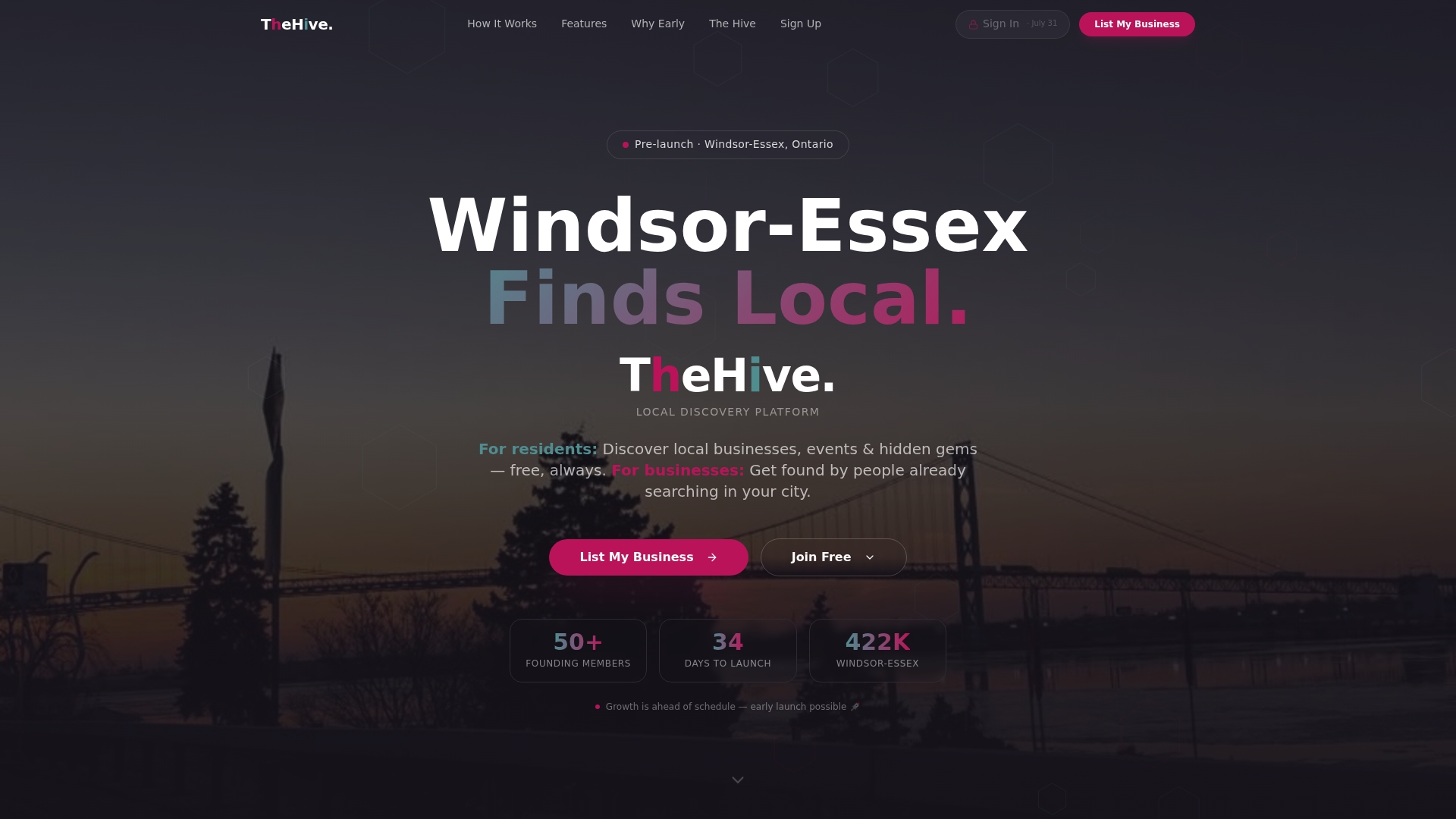
Residents can join and verify their address in minutes. Local businesses can claim a free listing and start collecting community reviews through the features page. Community organizers looking to run outreach or volunteer coordination through the platform are welcome to reach out directly. Windsor-Essex deserves a local platform that works for the people who actually live here.
Sources and further reading
- ActivityPub federation architecture explained — Idealogic community platform build guide
- How to build a website like Nextdoor — Sharetribe verification and moderation guidance
- Neighbourhood Networks Model — Centre for Ageing Better, Leeds secondary prevention evidence
- Community vs. Audience vs. Network: 2026 Framework — gate mechanics and value trade-offs
- Community platform development architecture guide — Zulbera, notification and real-time stack guidance
- Benefits of Neighborhood Networks Centers — U.S. Department of Housing and Urban Development
- Community networking benefits in Windsor-Essex — Thehivewindsor blog, local examples and metrics
- Local event promotion for Windsor-Essex organizers — Thehivewindsor blog, practical event calendar guidance