

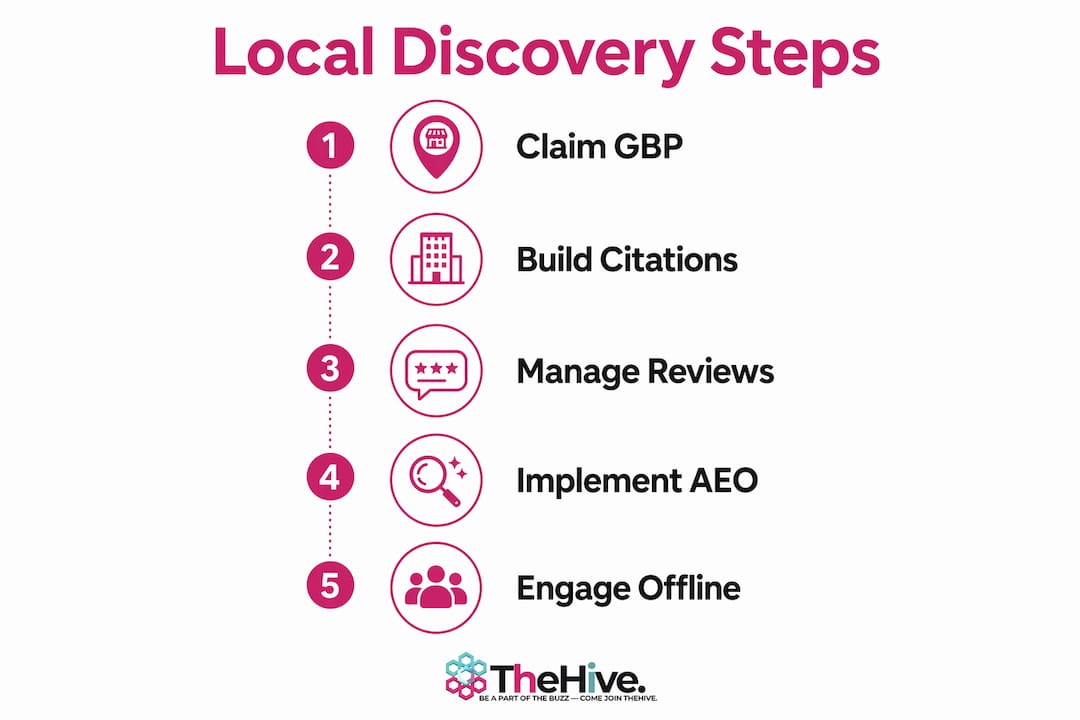
Local business discovery is defined as the process by which nearby consumers find and choose a business through digital listings, search engines, reviews, and community engagement. How new businesses get discovered locally depends on four core signals: an active Google Business Profile, consistent citations, authentic reviews, and offline community presence. 78% of consumers search for local businesses online more than once a week, with 21% searching every day. That frequency means your window to capture attention is constant, and missing even one channel costs you real customers.
How new businesses get discovered locally: the core framework
Local discovery is not a single tactic. It is a system of overlapping signals that search engines and consumers use together to decide which business to trust. The industry term for managing these signals is local SEO, and it covers everything from your Google Business Profile to the consistency of your phone number across directories.
New businesses often make the mistake of treating local visibility as a one-time setup task. Search engines reward ongoing activity, not a profile you claim and forget. The businesses that rank at the top of local results are the ones that post regularly, respond to reviews, and keep their information current.
The good news is that the framework is learnable and repeatable. You do not need a large ad budget to compete. You need consistency, accuracy, and community engagement.

What role does Google Business Profile play in local business discovery?
Google Business Profile (GBP) is the single most important tool for local business visibility. Map Pack rankings are determined primarily by GBP signals, which account for 32–36% of ranking weight, followed by review signals at 16–20%, and proximity. Map Pack appearances capture 60–75% of all local service inquiry calls. That is the top of the page, and it is free to claim.
Claiming and verifying your GBP early is the first step every new business must take. Video verification is now the industry-standard method to prove physical business presence to Google, and it moves faster than the old postcard method. Complete every section of your profile: business categories, services, hours, photos, and the Q&A section.
Once your profile is live, active management is what separates ranked businesses from invisible ones. Weekly GBP posts and frequent photo uploads contribute directly to activity signals that drive local search rankings. Responding to reviews within 48 hours is standard best practice and signals legitimacy to both Google and potential customers.
Key actions to prioritize on your GBP:
- Select your primary and secondary business categories carefully, since categories are a top ranking signal.
- Upload at least 10 photos at launch, including interior, exterior, and product or service shots.
- Add posts weekly, even short ones announcing hours, offers, or community involvement.
- Answer every question in the Q&A section yourself before customers ask them.
- Respond to every review, positive or negative, within 48 hours.
Pro Tip: Configure your GBP service areas using explicit city names and ZIP codes rather than a broad radius setting. Explicit service-area naming generates stronger proximity signals and improves your ranking for specific neighborhood searches.
How do citations and online directories impact new local business visibility?
A citation is any online mention of your business name, address, and phone number, commonly called NAP data. Search engines use citation consistency as a trust signal. If your address appears differently across directories, your ranking suffers.
New businesses should build 30–40 high-value citations during their first 60–90 days. Manual citation building is preferred over automated subscription services because automated tools often introduce formatting inconsistencies that take months to clean up. Take the time to submit each listing yourself.
The core directories every new business should prioritize are Yelp, Nextdoor, Bing Places, Apple Maps, and your local Chamber of Commerce. Each one serves a different audience segment and search engine ecosystem.
| Directory | Strength | Watch out for |
|---|---|---|
| Yelp | High consumer trust, strong SEO authority | Review filtering can hide early reviews |
| Nextdoor | Hyper-local neighborhood reach | Smaller audience, slower growth |
| Bing Places | Powers Siri and Alexa local results | Often overlooked by new businesses |
| Apple Maps | Critical for iPhone users | Requires Apple ID to claim and verify |
| Chamber of Commerce | Authoritative .org backlink | May require membership fee |
Consistency across all listings is non-negotiable. Use the exact same business name, address format, and phone number on every platform. Even small differences, like "St." versus "Street," create conflicting signals that weaken your local authority.
In what ways do reviews and reputation management drive local discovery?
Reviews are the second-largest ranking factor in local search, and they are the first thing consumers read before choosing a business. Generating at least 5–10 reviews quickly after launch builds the trust threshold most consumers require before making contact. A profile with zero reviews is effectively invisible to high-intent buyers.
Review velocity matters as much as review count. Search engines interpret a steady stream of new reviews as a sign that the business is active and legitimate. A business that collected 20 reviews at launch and then stopped looks stale compared to one that earns 2–3 reviews per month consistently.
Requesting reviews ethically is straightforward. Ask satisfied customers directly, in person or via a follow-up text or email, with a direct link to your GBP review page. Never offer incentives for reviews. That practice violates Google's terms of service and can result in penalties.
Best practices for review management:
- Send review requests within 24 hours of a completed service, when the experience is fresh.
- Respond to every negative review calmly and professionally, offering to resolve the issue offline.
- Use positive reviews as content for social media posts to extend their reach.
- Monitor your review profiles weekly so no feedback goes unaddressed.
Pro Tip: Create a short URL redirect, like yourbusiness.com/review, that sends customers directly to your GBP review form. Removing friction from the process increases the rate at which satisfied customers follow through.
What offline strategies reinforce local online discovery?
Offline activity creates online signals. This is the Offline-to-Online Loop, and it is one of the most underused strategies for new businesses. Sponsoring local events, issuing press releases, and forming partnerships generate authoritative backlinks from .gov and .org domains, which carry significant weight in local search rankings.
Here is how to build that loop systematically:
- Sponsor a local event or sports team. Event organizers typically list sponsors on their websites, earning you a backlink and a citation. The cost is often low, and the community visibility is immediate.
- Send a press release to local media. A new business opening is newsworthy. Local newspapers and community blogs will often publish it, creating a citation and a backlink from a trusted domain.
- Partner with complementary businesses. A new bakery partnering with a local coffee roaster for a joint promotion earns cross-promotion on both websites and social channels, doubling the digital reach.
- Attend Chamber of Commerce events. In-person networking leads to referrals, and referrals often result in online reviews and social mentions that feed back into your digital authority.
- Document everything for content. Every event you attend, every partnership you announce, and every community moment you participate in becomes a Google Post, a social media update, or a photo upload that signals ongoing activity to search engines.
The Offline-to-Online Loop works because search engines cannot directly observe your community involvement. They rely on the digital traces that offline activity leaves behind: backlinks, citations, mentions, and content. Effective local marketing reinforces digital rankings with physical community presence and ongoing content creation.
How do AI search and voice assistants influence local discovery in 2026?
AI Engine Optimization (AEO) is the practice of structuring your website and digital content so that AI assistants can read, understand, and recommend your business. It is a newer discipline that sits alongside traditional local SEO, and new businesses that ignore it are already falling behind.
AI assistants like ChatGPT prioritize structured website content with detailed FAQs and service-area pages when making local business recommendations. A thin, generic website with no specific service information will rank lower in AI-driven discovery, even if the GBP is fully optimized. The website and the GBP must work together.
New businesses should create service-area pages targeting specific cities and ZIP codes, including pricing ranges and process details. These pages give AI assistants the structured data they need to match your business to a user's specific query. Schema markup, which is a type of code that labels your content for search engines and AI tools, adds another layer of clarity.
Pro Tip: Publish a dedicated FAQ page on your website that answers the exact questions your customers ask most often. AI assistants pull directly from well-organized FAQ content when generating local business recommendations, giving structured sites a clear advantage over generic ones.
Key Takeaways
Local business visibility depends on an integrated system of GBP management, consistent citations, authentic reviews, offline community engagement, and structured website content working together continuously.
| Point | Details |
|---|---|
| Claim your GBP immediately | Verify via video and complete every profile section before your first customer searches for you. |
| Build 30–40 citations in 90 days | Submit manually to core directories to keep NAP data consistent and trustworthy. |
| Generate reviews early and often | Aim for 5–10 reviews at launch, then maintain steady velocity with direct review requests. |
| Use offline activity as online fuel | Sponsorships, press releases, and partnerships create backlinks and citations that boost rankings. |
| Structure your site for AI discovery | Publish service-area pages, FAQs, and schema markup so AI assistants can recommend your business. |
What I have learned from watching businesses get this wrong
Most new business owners treat local discovery like a launch checklist. They claim the GBP, add a few photos, and move on. Six months later, they wonder why a competitor with half the quality is ranking above them. The answer is almost always activity. The competitor posts weekly. They respond to every review. They show up at community events and document it online.
The businesses I have seen grow fastest in their first year treat local visibility as a living system, not a setup task. They check their GBP insights every week. They notice which posts get engagement and do more of that. They ask for reviews after every job, not just occasionally. That consistency compounds over time in a way that no ad spend can replicate.
One thing that surprises most new owners is how much offline behavior matters online. Showing up to a Chamber of Commerce meeting, sponsoring a little league team, or getting a mention in the local paper creates digital signals that paid ads simply cannot buy. Search engines trust community proof. So do customers.
The other mistake I see constantly is ignoring the AI shift. Businesses that built strong GBPs in 2023 and 2024 are now losing ground to competitors whose websites are structured for AI assistants to read. If your website is a single page with a phone number and a contact form, you are invisible to ChatGPT and Perplexity when someone asks for a local recommendation. Fix that now, not later.
— randy
Thehivewindsor: built for local businesses that want to be found
Getting discovered in Windsor-Essex should not require a marketing degree or a big ad budget. Thehivewindsor is a local search and discovery platform built specifically for this community, from hobbyists earning side income to businesses that have been operating for decades.
Unlike platforms that rank businesses based on who pays the most, Thehivewindsor's listing algorithm ranks businesses based on the reviews and community love they earn. That means a new business with genuine customer support can outrank an established one that stopped engaging. You get one place to manage your local presence, connect with Windsor-Essex customers, and track how your community reputation grows. Sign up on Thehivewindsor and put your business in front of the people already looking for what you offer.
FAQ
How long does it take for a new business to appear in local search?
Most new businesses begin appearing in local search results within 2–4 weeks of claiming and verifying their Google Business Profile. Full Map Pack visibility typically develops over 60–90 days as citations and reviews accumulate.
How many citations does a new business need to rank locally?
Building 30–40 consistent, high-quality citations during the first 60–90 days establishes the foundational trust signals search engines use to rank local businesses. Consistency in NAP data across all listings is more important than volume alone.
Do reviews actually affect local search rankings?
Review signals account for 16–20% of Google's Map Pack ranking factors, making them the second-largest ranking category after GBP signals. Review velocity, meaning how regularly new reviews arrive, matters as much as total review count.
What is AEO and why does it matter for local businesses in 2026?
AI Engine Optimization (AEO) is the practice of structuring website content so AI assistants like ChatGPT and Perplexity can read and recommend your business. Businesses with detailed FAQs, service-area pages, and schema markup are significantly more likely to appear in AI-driven local recommendations.
Can a new business compete locally without paid advertising?
A new business can build strong local visibility without paid ads by actively managing its GBP, building citations manually, generating reviews consistently, and participating in community events that create organic backlinks and citations.