

A neighbourhood business hub is defined as a localized center that combines physical workspace, business support services, and community programming to help entrepreneurs grow without leaving their own neighborhoods. This concept goes far beyond a shared desk or coworking room. The standard industry term is "business support hub," and understanding that distinction matters because it shapes what you should expect from one. Michigan's Small Business Support Hubs program served over 7,500 businesses and supported 28,000 jobs by mid-2025, proving that neighbourhood business hub explained properly is not a trend but a proven economic model. Thehivewindsor applies this same logic digitally for Windsor-Essex, connecting local businesses through a community-first discovery platform.
What are the essential features of a neighbourhood business hub?
A business hub is defined by its programming, not just its physical space. Hubs act as a center of gravity that connects members to resources, partners, and momentum. That is what separates a true community business center from a room with Wi-Fi and a coffee machine.
The physical layer typically includes:
- Hot desks, private offices, and bookable meeting rooms
- High-speed internet, printing, and mail handling
- On-site administrative support and business consultations
- Shared amenities like kitchens, reception areas, and event space
The programmatic layer is where the real value lives. Coaching sessions, mentor matchmaking, workshops on topics like cash flow or digital marketing, and curated networking events all define a hub's character. Hubs with layered programming combining space, coaching, and partner referrals produce stronger business outcomes than facilities offering workspace alone. That finding should change how you evaluate any hub you consider joining.
Pro Tip: When assessing a hub, ask specifically about its mentor network and referral partnerships. A hub with 10 active mentors and three anchor partner organizations will do more for your business than one with 50 desks and no programming.

Trust is also a core feature. Neighbourhood hubs centralize reputation and reduce consumer uncertainty in local commerce. When a hub vouches for its members through shared events and visible community presence, it transfers credibility to every business inside it.
How do neighbourhood business hubs impact local economies?
The economic case for community business centers is well documented. Michigan's Small Business Support Hubs program demonstrates what scale looks like: 28,000 jobs supported through coaching, workshops, and mentor matchmaking across thousands of businesses. That figure represents real households, real spending, and real tax revenue staying inside a region.
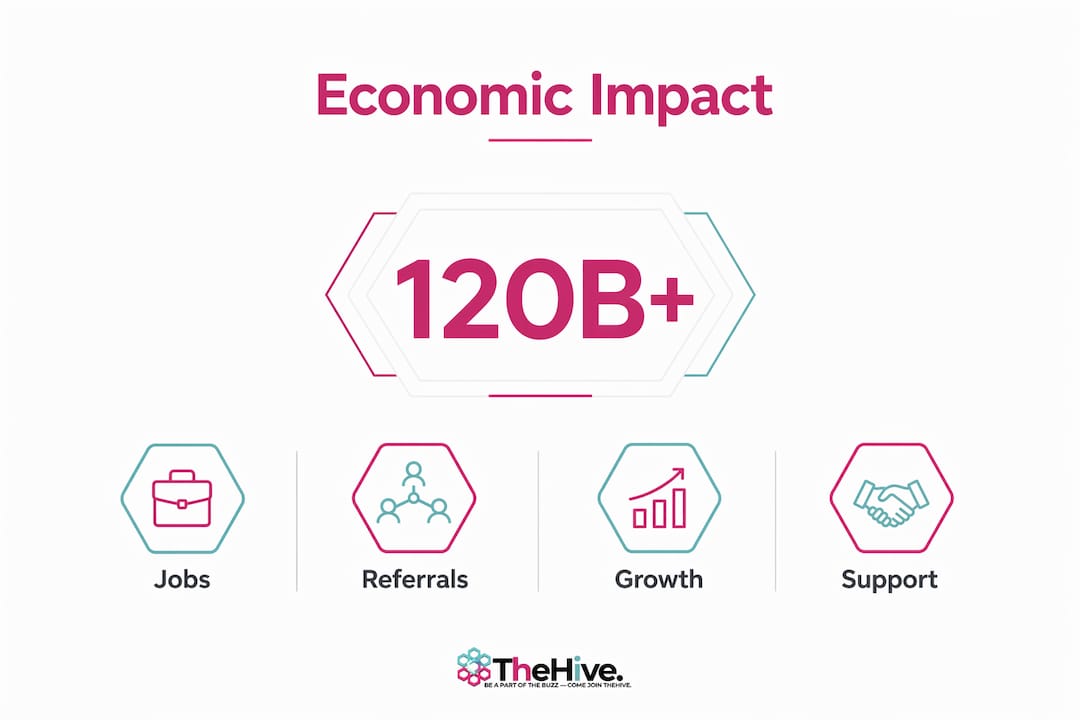
The global neighbourhood e-commerce market reflects the same momentum. The market is valued at $120 billion as of Q1 2026 and growing at a CAGR of 14.1%. Projections place it at $345 billion by 2034. That growth is driven by consumers choosing local, on-demand services over distant alternatives, and business hubs are the infrastructure that makes local supply reliable enough to meet that demand.
Hubs also rebuild what economists call social infrastructure. When a neighbourhood has a visible center for commerce and collaboration, foot traffic increases, vacant storefronts fill, and the local tax base strengthens. This is the Main Street revitalization effect in practice. Windsor-Essex has seen similar dynamics play out in its core commercial corridors, where clusters of connected businesses outperform isolated ones.
The economic resilience argument is equally strong. Businesses that share resources, referrals, and knowledge inside a hub are less vulnerable to individual shocks. A freelance designer who loses a major client can find a replacement project through a hub referral within days. That speed of recovery is not available to isolated sole proprietors.
| Economic benefit | What it means for Windsor-Essex |
|---|---|
| Job creation and retention | Local hubs keep employment dollars circulating inside the region |
| Increased foot traffic | Hub activity draws customers to surrounding businesses |
| Reduced business failure rates | Shared coaching and mentorship lower the risk of early closure |
| Stronger tax base | More viable local businesses generate more municipal revenue |
What operational models and pricing structures do hubs use?
Neighbourhood business hubs use several ownership and pricing models, and the choice of model determines long-term affordability. The two dominant structures are nonprofit or cooperative ownership and for-profit management.
The nonprofit or cooperative approach is often called the "good landlord" model. Nonprofits or cooperatives own the commercial property, which prevents rent escalation and protects the local economic fabric from gentrification. This model prioritizes mission over margin and keeps space accessible to micro-businesses and startups that cannot afford market-rate offices.
For-profit hubs rely on tiered pricing to balance accessibility with revenue. Typical pricing includes $29 per month memberships and $5 drop-in fees for flexible workspace. That pricing structure makes a hub accessible to a hobbyist testing a side business and a 10-person startup alike. The tiered approach is the most common model in North American community business centers.
Sustainable hubs use a mix of memberships, services, grants, and social enterprise ventures to stay affordable and functional. Cross-subsidization is the key mechanism. A hub might charge market rate for printing or notary services, then use that revenue to keep desk memberships below $50 per month. This approach protects the members who need affordability most while keeping the hub financially viable.
Pro Tip: Before committing to a hub membership, ask for a breakdown of its revenue sources. A hub that relies entirely on desk fees is one vacancy crisis away from closing. One with grants, service revenue, and anchor tenants will still be there in three years.
How can Windsor-Essex entrepreneurs engage with or start a hub?
Windsor-Essex entrepreneurs have a clear path to engaging with the local business network, whether they want to join an existing hub or build one from scratch.
-
Map what already exists. Search for existing community business centers, incubators, and coworking spaces in Windsor and Essex County. The Windsor-Essex Economic Development Corporation and local BIAs maintain directories of business support resources. Start there before building anything new.
-
Define your radius. Hyperlocal platforms succeed within a 1–5 mile radius, where supply and demand density is high enough to create real value. Choose or locate your hub where your target members can reach it without a significant commute.
-
Build anchor partnerships first. A hub without anchor partners is just a room. Approach local organizations, credit unions, accounting firms, and legal clinics about providing programming. These partners bring credibility and members from day one.
-
Choose your ownership model early. Decide whether you are building a nonprofit, a cooperative, or a for-profit entity before signing any lease. The ownership structure determines your funding options, your pricing flexibility, and your long-term mission.
-
Connect with Thehivewindsor. Thehivewindsor operates as Windsor-Essex's local discovery platform, connecting businesses across the region through a review-driven, ad-free algorithm. Listing your hub or business on Thehivewindsor puts you in front of local entrepreneurs actively searching for community business connections.
Neighbourhood coworking is vital infrastructure, not a luxury, according to Suzanne Murdock of The Hub Newry. That framing should guide every decision Windsor-Essex entrepreneurs make about hubs. Treat the hub as a public good that happens to need a business model, and you will make better decisions about pricing, programming, and partnerships.
Pro Tip: Start with programming before you sign a lease. Run a monthly networking breakfast or workshop series in a borrowed space. If 20 people show up consistently, you have proof of demand. That proof is what landlords, funders, and partners need to see.
Key Takeaways
A neighbourhood business hub is defined by its programming and community infrastructure, not its square footage. The hubs that create lasting economic impact combine affordable workspace with coaching, mentorship, and partner networks.
| Point | Details |
|---|---|
| Hubs are defined by programming | Space alone does not create economic impact; coaching and mentorship are the differentiators. |
| Economic returns are documented | Michigan's program supported 28,000 jobs, proving hubs deliver measurable regional value. |
| Pricing must stay accessible | Tiered memberships and cross-subsidized services keep hubs viable for micro-businesses. |
| Ownership model shapes longevity | Nonprofit and cooperative ownership prevents rent escalation and protects affordability. |
| Windsor-Essex has a clear entry point | Thehivewindsor connects local entrepreneurs to a community-first local business network. |
Why I think most people misread what a hub actually is
Most entrepreneurs I talk to in Windsor-Essex picture a hub as a building. They think about desks, meeting rooms, and maybe a coffee bar. That mental model causes them to undervalue what a hub actually does and overpay for what it does not.
The real product a hub sells is momentum. When you are working alone from a home office, you have no one to pressure-test your pricing, no one to refer you to their accountant, and no one to tell you that the city just announced a grant your business qualifies for. A hub fixes all three of those problems simultaneously. The desk is just the excuse to show up.
Post-pandemic, this matters more than it did in 2019. The isolation of remote work hollowed out a lot of the informal knowledge-sharing that used to happen in offices and at industry events. Hubs rebuild that connective tissue. They are where you find out that the person two desks over just solved the exact problem you have been stuck on for six weeks.
My honest view is that Windsor-Essex is underserved by formal hub infrastructure relative to its business population. The demand is there. The entrepreneurs are there. What is missing is the physical and digital connective tissue that turns a collection of independent businesses into a functioning local economy. Thehivewindsor is part of that connective tissue on the digital side. The physical side still needs more investment and more community will to treat it as infrastructure rather than a nice-to-have.
If you run a business in Windsor-Essex and you are not actively participating in some form of local business network, you are leaving referrals, knowledge, and resilience on the table. That is not a philosophical point. It is a practical one.
— randy
Thehivewindsor and the Windsor-Essex local business network
Thehivewindsor is Windsor-Essex's local search and discovery platform, built to give every business in the region equal visibility without paying for ad placement.
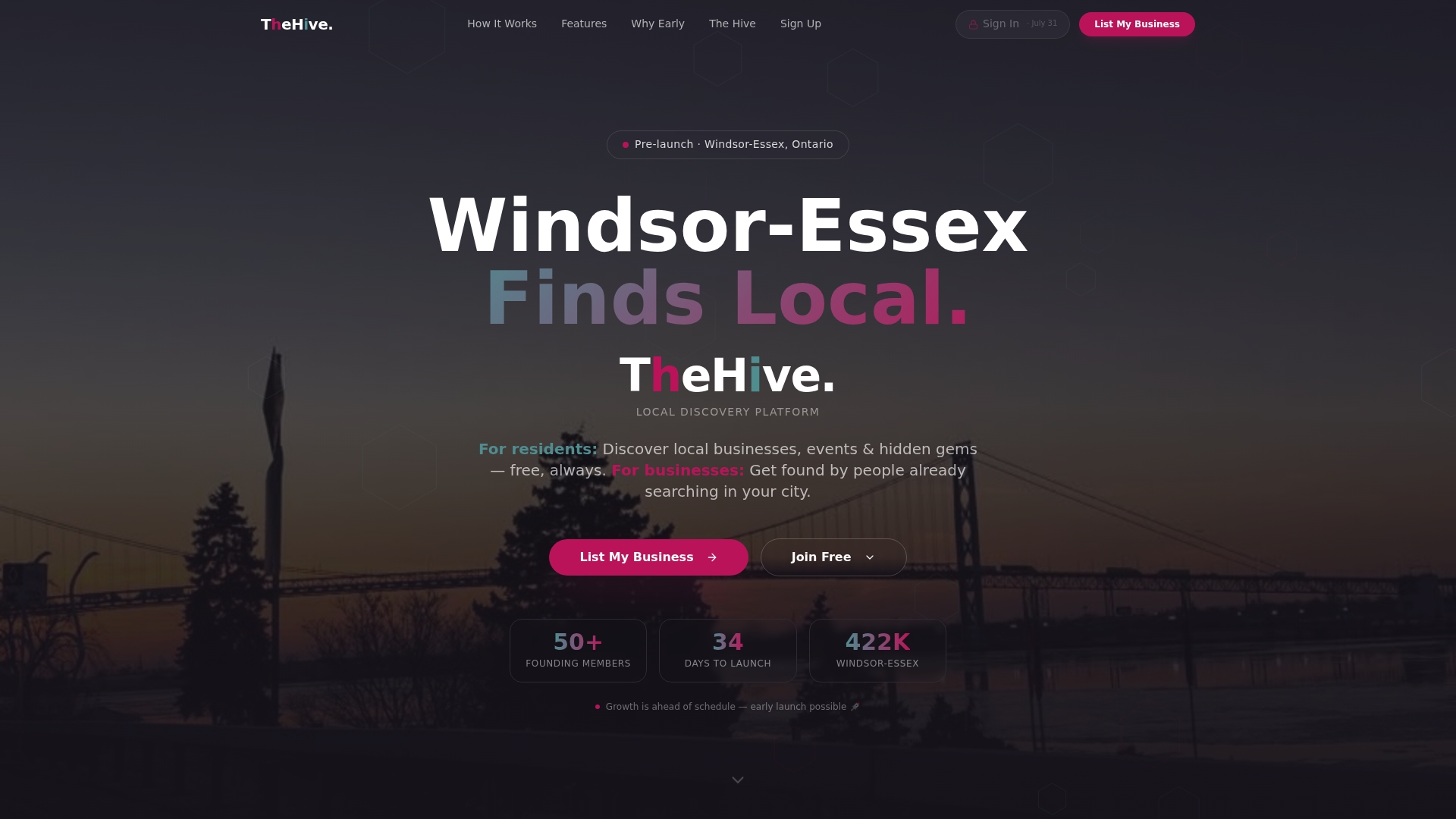
The platform ranks businesses based on reviews and community engagement, not ad spend. That means a 40-year-old family business and a brand-new side hustle compete on the same terms: the quality of their work and the loyalty of their customers. Thehivewindsor functions as a digital neighbourhood business hub, connecting entrepreneurs, hobbyists, startups, and established companies through one platform instead of scattered apps and directories. Join the Windsor-Essex community and put your business in front of local customers who are actively looking for what you offer.
FAQ
What is a neighbourhood business hub?
A neighbourhood business hub is a localized center combining workspace, business coaching, mentorship, and community programming to support local entrepreneurs. It differs from a standard coworking space by providing structured support that connects members to resources and growth opportunities.
How do business hubs support economic development in neighborhoods?
Business hubs create jobs, increase local foot traffic, and reduce business failure rates by giving entrepreneurs access to shared resources and mentorship. Michigan's Small Business Support Hubs program supported 28,000 jobs through this model by mid-2025.
What does a neighbourhood business hub typically cost?
Pricing varies by model, but typical structures include monthly memberships around $29 and drop-in fees as low as $5. Sustainable hubs supplement membership revenue with grants, service fees, and social enterprise income to keep costs low.
How do I find or start a community business center in Windsor-Essex?
Start by mapping existing resources through the Windsor-Essex Economic Development Corporation and local BIAs. If no hub fits your needs, begin with a recurring programming event in a borrowed space to prove demand before committing to a lease.
How does Thehivewindsor function as a local business network?
Thehivewindsor is a Windsor-Essex discovery platform that connects local businesses and customers through a review-driven algorithm with no paid rankings. It serves as a digital hub for neighbourhood commerce, giving every business equal access to local visibility.