

A local business ecosystem is defined as a dynamic network of enterprises, suppliers, consumers, public institutions, and support services that create shared economic, social, and environmental value within a specific geographic area. The term comes from biology, where ecosystems describe interdependent organisms. In business, the recognized industry term is "entrepreneurial ecosystem," and the local variant applies that same logic to a neighborhood, city, or region. For Windsor-Essex business owners, understanding this system is the difference between operating in isolation and growing as part of something larger.
The ecosystem concept matters because local economic prosperity depends on the health of the entire network, not just individual businesses. When a bakery, a florist, and a coffee shop share customers, coordinate hours, and refer each other, all three grow faster than any one would alone. Thehivewindsor was built on exactly this principle: give every Windsor-Essex business, from a weekend hobbyist to a 40-year-old company, equal access to the community without requiring ad spend to be seen.
What is a local business ecosystem made of?
A local business ecosystem includes six core categories of actors. Each one plays a distinct role, and the network only functions when they interact.
Businesses and suppliers form the commercial core. This includes retailers, service providers, manufacturers, and the vendors who supply them. In Windsor-Essex, that means everyone from auto parts distributors to independent restaurants sourcing from local farms.
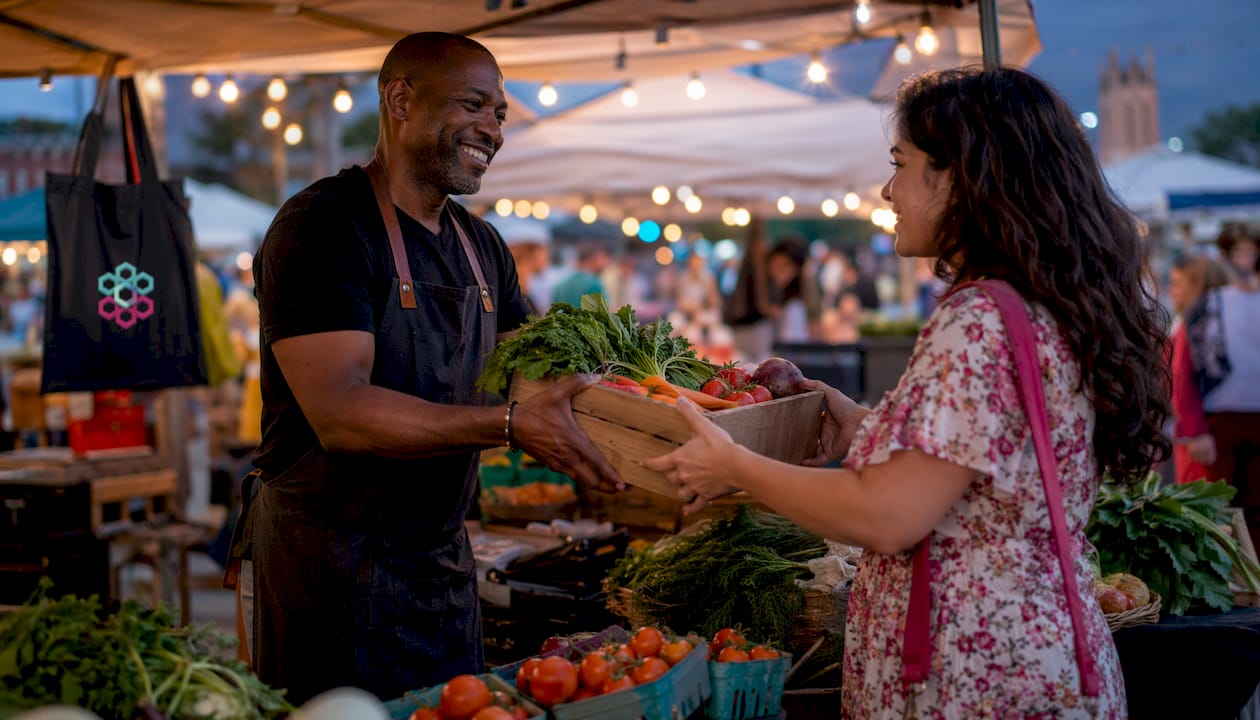
Customers and labor pools are the human fuel. Regular customers drive repeat revenue. Local workers bring skills, spend their wages locally, and connect businesses to community networks. Entrepreneurial ecosystems require accessible mentorship, aligned workforce training, and clear pathways to capital to function well.
Public institutions and regulatory bodies set the rules and provide infrastructure. Municipal governments, zoning boards, and economic development offices shape where businesses can operate and how they grow. Windsor-Essex has the Windsor-Essex Economic Development Corporation as one example of this layer.
Financial institutions and capital providers fund growth. Community credit unions, angel investors, and small business loan programs all feed the ecosystem. Without accessible capital, underserved entrepreneurs cannot enter or scale.
Educational establishments train the next generation of workers and entrepreneurs. Colleges like St. Clair College and the University of Windsor feed talent directly into the local economy.
Support organizations include chambers of commerce, business improvement areas, and nonprofit accelerators. They coordinate resources, host networking events, and advocate for policy changes that benefit local business networks.
| Ecosystem Layer | Key Actors | Primary Function |
|---|---|---|
| Commercial | Businesses, suppliers | Generate revenue, create jobs |
| Human | Customers, workers | Drive demand, supply skills |
| Institutional | Government, regulators | Set rules, provide infrastructure |
| Financial | Banks, investors, lenders | Fund growth and operations |
| Educational | Colleges, training programs | Develop local talent |
| Support | Chambers, accelerators | Coordinate and advocate |
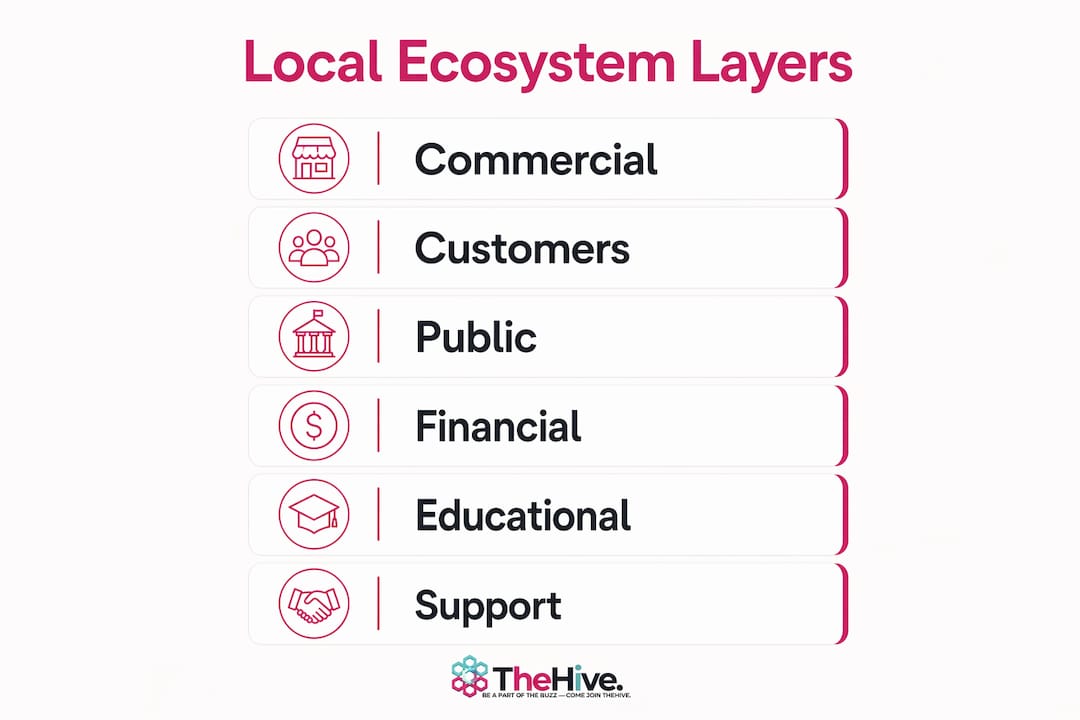
The table above shows why no single business operates in a vacuum. Every layer feeds the others. A gap in any one of them, say a shortage of skilled workers or a lack of accessible loans, weakens the entire system.
How does the neighborhood network effect drive local business growth?
The neighborhood network effect is the single most powerful growth lever inside a local ecosystem. Regular customers generate 6x more revenue than casual shoppers. That gap is not marginal. It means a business with 100 loyal regulars outperforms one with 600 one-time visitors.
The deeper insight from Square's 2026 Local Economy Report is about sharing. 32% of regular customers are shared by businesses within the same ZIP code. That means your best customers are also your neighbor's best customers. Competing for them makes no sense. Collaborating to keep them in the neighborhood does.
Regular customers are not just loyal to one store. They are loyal to a neighborhood. Businesses that recognize this and collaborate with nearby sellers capture far more of that loyalty than those that treat every customer as exclusively theirs.
The practical benefits of activating this effect include:
- Higher average transaction values because regulars trust the businesses they know and spend more per visit.
- Lower customer acquisition costs because word-of-mouth from regulars replaces paid advertising.
- Cross-referral traffic when neighboring businesses recommend each other directly.
- Resilience during slow periods because a loyal base provides predictable revenue even when foot traffic drops.
- Stronger community reputation because regulars become advocates who bring in new customers organically.
Pro Tip: Map your top 20% of customers and ask which other local businesses they visit regularly. Those neighbors are your best collaboration partners, not your competition.
Local commerce driven by connectedness consistently outperforms isolated business models in both revenue and resilience. The neighborhood network effect is not a theory. It shows up in the numbers.
What strategies build and sustain a thriving local business ecosystem?
Building a healthy ecosystem requires more than a networking event or a shared social media post. Effective ecosystems prioritize community-led, place-based initiatives that reflect the actual lived experience of the people in them. Generic, top-down approaches consistently fail because they ignore local culture, economic realities, and existing relationships.
The following pillars define what works:
-
Lead with community, not programs. Ecosystems built around grassroots relationships outlast those built around grant cycles. Start by identifying who already connects people in your area, whether that is a longtime business owner, a neighborhood association, or a local market organizer.
-
Coordinate instead of compete. Business ecosystems thrive when actors align on shared goals rather than fighting for market share. Align store hours with neighboring businesses. Co-host events. Share customer lists with consent.
-
Include underserved entrepreneurs intentionally. Ecosystems that exclude new entrants, whether due to cost, language, or lack of connections, shrink over time. Actively recruit businesses from underrepresented communities. They bring new customers and new energy.
-
Invest in physical infrastructure. Walkable neighborhoods with complementary businesses generate more multi-stop consumer visits. A customer who parks once and visits three stores spends more overall than one who drives to a single destination. Advocate for sidewalks, parking, and signage that makes your area easy to explore on foot.
-
Engage funders focused on long-term trust. Short-term grants that disappear after 12 months do not build ecosystems. Seek out capital providers and institutional partners willing to invest in relationships and infrastructure over years, not quarters.
-
Measure what matters locally. Track customer retention rates, cross-referral volume, and local spending patterns. These metrics reveal ecosystem health far better than total sales figures alone.
Pro Tip: Before launching any collaboration, agree on one shared goal with your neighboring businesses, such as increasing foot traffic on a specific day of the week. A single focused objective produces faster results than a broad partnership with no clear outcome.
Ecosystems that center on grassroots leadership and alignment around purpose sustain greater collective success than those driven by competition for credit or visibility.
How can Windsor-Essex businesses use ecosystem insights to grow?
Windsor-Essex has a geography that naturally supports ecosystem thinking. The region spans a mix of urban corridors in Windsor and smaller communities in Essex County, which means businesses can build dense neighborhood networks in the city and anchor-style networks in smaller towns. The principles are the same. The tactics shift slightly by location.
Here is how Windsor-Essex business owners can put ecosystem insights to work right now:
- Identify your shared customer base. Talk to two or three neighboring businesses and compare notes on who your regulars are. You will likely find significant overlap. That overlap is your collaboration opportunity.
- Align your hours with foot traffic patterns. If the coffee shop next door draws a morning crowd, stay open during those hours. If a restaurant nearby drives evening traffic, coordinate your closing time accordingly.
- Use digital discovery tools to extend your reach. Platforms built for local business visibility help customers find you without requiring paid advertising. Thehivewindsor ranks businesses based on community reviews and engagement, not ad spend. That levels the playing field for newer businesses competing against established ones.
- Cross-promote with complementary businesses. A Windsor gym and a local smoothie bar serve the same customer at different points in the same routine. A joint promotion costs almost nothing and reaches both audiences at once.
- Participate in local discovery networks. Understanding how new businesses get discovered in 2026 means showing up where local customers actually search, which increasingly means community-driven platforms rather than generic national directories.
- Build relationships before you need them. The best time to connect with a neighboring business is before a slow season, not during one. Relationships built on mutual respect produce faster results than transactional partnerships formed out of desperation.
The Windsor-Essex ecosystem also benefits from its cross-border position near Detroit. That proximity creates unique opportunities for businesses in tourism, hospitality, and retail to attract customers from across the border who are specifically seeking local, independent experiences they cannot find in chain-dominated American suburbs.
Key Takeaways
A local business ecosystem grows fastest when businesses treat their neighbors as partners, not competitors, and when the entire network prioritizes shared customers, walkable infrastructure, and long-term community trust.
| Point | Details |
|---|---|
| Core definition | A local ecosystem is a network of businesses, institutions, customers, and support services creating shared value in one geographic area. |
| Neighborhood network effect | Regular customers generate 6x more revenue and 32% are shared across businesses in the same ZIP code. |
| Collaboration over competition | Aligning store hours, cross-promoting, and sharing referrals produces stronger growth than competing for the same customers. |
| Community-led strategies work | Ecosystems built on grassroots relationships and local lived experience outlast top-down programs. |
| Digital visibility matters | Platforms like Thehivewindsor help Windsor-Essex businesses gain discovery without requiring ad spend. |
What I've learned watching Windsor-Essex businesses grow together
Most business owners I talk to think about their ecosystem in terms of competition. Who else sells what I sell? How do I stand out? That framing is understandable, but it misses the bigger picture entirely.
The businesses I have watched grow fastest in this region are not the ones with the biggest marketing budgets. They are the ones that know their neighbors. They send customers across the street. They text each other when a supplier has a deal. They show up at each other's events. That behavior is not altruism. It is a growth strategy grounded in how local economies actually work.
The misconception I hear most often is that a strong local ecosystem requires a formal structure, a committee, a program, a grant. It does not. It requires trust, and trust gets built one conversation at a time. The community support that sustains local businesses rarely comes from an institution. It comes from the business owner two doors down who tells their customers about you.
Windsor-Essex has something genuinely worth protecting here. The region has enough density to create real neighborhood network effects and enough community identity to make local loyalty mean something. The businesses that recognize that and act on it now will be the ones still standing in ten years.
— randy
Thehivewindsor: your Windsor-Essex ecosystem hub
Windsor-Essex businesses deserve a platform that works the same way the ecosystem does: based on reputation, not budget.
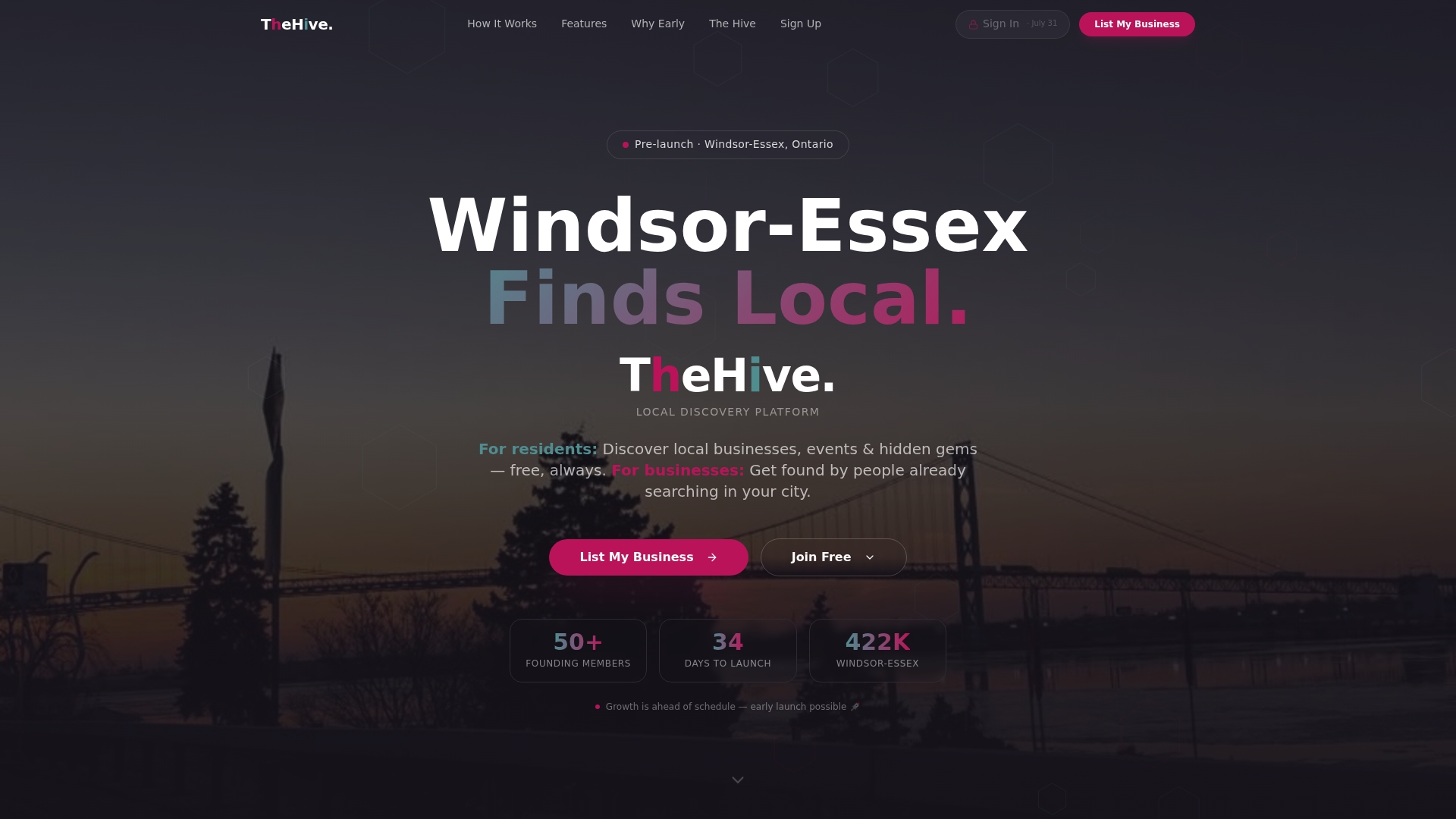
Thehivewindsor is a local discovery and community networking platform built specifically for Windsor-Essex. The ranking algorithm surfaces businesses based on community reviews and engagement, not paid placement. That means a new startup and a 40-year-old company compete on the same terms: the quality of their relationships with customers. Whether you are a hobbyist selling on the side or a full-time entrepreneur, you can list your business and connect with the customers and collaborators already looking for what you offer. No ad spend required. No jumping between apps. Just one place for everything happening in Windsor-Essex.
FAQ
What is a local business ecosystem?
A local business ecosystem is a network of businesses, customers, institutions, and support services within a geographic area that interact to create shared economic and social value. It functions like a biological ecosystem, where every actor depends on the health of the others.
What is the neighborhood network effect?
The neighborhood network effect describes how regular customers are shared across businesses in the same area, with 32% of regulars visiting multiple businesses in the same ZIP code. Businesses that collaborate to capture this shared loyalty earn significantly more than those operating in isolation.
Why do local business ecosystems fail?
Most ecosystems fail because they rely on generic, top-down programs that do not reflect local culture or economic realities. Sustainable ecosystems require community-led leadership, long-term trust, and intentional inclusion of underserved entrepreneurs.
How do Windsor-Essex businesses benefit from ecosystem thinking?
Windsor-Essex businesses benefit by identifying shared customer bases with neighbors, aligning store hours, cross-promoting with complementary businesses, and using community-driven platforms like Thehivewindsor to gain visibility without paid advertising.
How do local directories support the ecosystem?
Local directories help customers discover businesses they would not find through national search engines, increasing foot traffic and connecting businesses to the community networks that drive repeat visits and referrals.