

Yes, local listings directly increase visibility, trust, and bookings for tourism businesses. If you run a kayak tour, a B&B, or a regional attraction and you are not actively managing your listings, you are invisible to travelers searching right now on their phones. Three things you can do in the next seven days: claim your Google Business Profile, add a direct booking link to it, and upload at least 10 photos. Those three steps alone put you in front of travelers at the exact moment they are deciding where to spend money.
The evidence is hard to ignore. 46% of all Google searches carry local intent, and more than 57% of local searches happen on mobile. A traveler standing in a new city, searching "boat tours near me," is not going to scroll past the Maps Pack to find you. Either your listing is there, or a competitor's is.
Local listings also compound over time in a way paid ads never do. A well-optimized Google Business Profile keeps driving map impressions and calls long after you set it up. Ads stop the moment the budget runs out.
Quick-start actions (first 7 days):
- Claim and verify your Google Business Profile at business.google.com
- Add your booking URL to the "Book" or "Appointments" field
- Upload 10 or more high-quality photos showing your experience, not just your logo
- Confirm your NAP (name, address, phone) matches exactly across every directory
Table of Contents
- What a local business listing actually means for tourism operators
- Which listing sites tourism businesses should claim first
- The concrete benefits local listings deliver
- How to claim, verify, and publish listings that convert
- Optimization tactics that increase bookings from listings
- Managing listings at scale and measuring what is working
- Research-backed impact: what the data says about listings and local search
- Key Takeaways
- Why a locals-first listing strategy is the most durable play in tourism
- Thehivewindsor gives Windsor-Essex tourism businesses a different kind of visibility
- Useful sources and further reading
What a local business listing actually means for tourism operators
A local business listing is an online entry that publishes your business name, address or service area, phone number, hours, categories, photos, and booking links. Moz describes them as the digital equivalent of the Yellow Pages, but with far more functionality: reviews, Q&A, direct booking buttons, and structured attributes that search engines read to decide whether your business matches a traveler's query.
For tourism, the concept goes one step further. A generic listing just says you exist. A destination-optimized listing pairs your service type with location keywords, so "wine tours in Windsor" or "kayak rentals Essex County" surfaces your business when someone searches that exact phrase. That pairing is what separates a listing that drives bookings from one that just sits there.
| Listing type | What it includes | What it drives |
|---|---|---|
| Basic directory listing | Name, address, phone | Brand awareness, minimal search traffic |
| Destination-optimized listing | NAP + categories + destination keywords + photos | Local search visibility, pre-trip research clicks |
| Google Business Profile | Full NAP + booking link + reviews + Q&A + posts + attributes | Maps Pack placement, calls, direction requests, direct bookings |
The gap between a basic directory entry and a fully built-out Google Business Profile is not cosmetic. It is the difference between showing up in the Maps Pack and not showing up at all.
Which listing sites tourism businesses should claim first
Not all directories carry equal weight. Prioritize these four, in this order, and you will cover the vast majority of where travelers actually look.
1. Google Business Profile
GBP signals account for a significant share of local ranking factors, making it the single highest-leverage listing you can manage. A substantial share of local clicks go to the Maps Pack, and profile completeness is the biggest lever for getting into it. The most important field for bookings: your booking URL in the "Appointments" or "Book" button. Secondary priorities are your primary category (be specific: "kayak tour operator" beats "tour operator"), your service catalog, and a minimum of 10 photos.

2. TripAdvisor
TripAdvisor is where travelers go to validate a decision they are already leaning toward. It is pre-trip research territory, and a strong TripAdvisor profile with recent reviews can be the final nudge that converts a browser into a booker. The most important field: your response to every review, positive or negative. Operators who respond consistently signal credibility to both the algorithm and future guests.
3. Facebook Business / Facebook Local
Facebook functions as a social proof layer. Travelers check it to see recent activity, photos from real guests, and whether the business looks alive. The most important field: your "Book Now" button linked directly to your booking engine. Keep your hours current, since Facebook surfaces hours prominently on mobile and an outdated listing creates friction before a traveler even reaches your site.
4. Yelp
Yelp carries more weight in some markets than others, but for restaurants, tours, and attractions in US cities, it still ranks near the top of local search results. Business directories make up a notable portion of local-intent organic search results, and Yelp is one of the directories that consistently lands there. The most important field: your business categories. Yelp's algorithm relies heavily on category matching, so choose the most specific category available.
Beyond the big four: destination-specific citations from regional DMOs, chambers of commerce, and official tourism boards carry stronger trust signals than mass-market directories. A listing on your state's tourism board site or your regional visitors bureau passes link equity that Yelp simply cannot match.
Pro Tip: For in-destination discovery (travelers already in your area), prioritize Google Business Profile and Facebook. For pre-trip research (travelers planning from home), TripAdvisor and DMO listings do the heavier lifting. Build both, but if you are short on time, start with GBP.
The concrete benefits local listings deliver
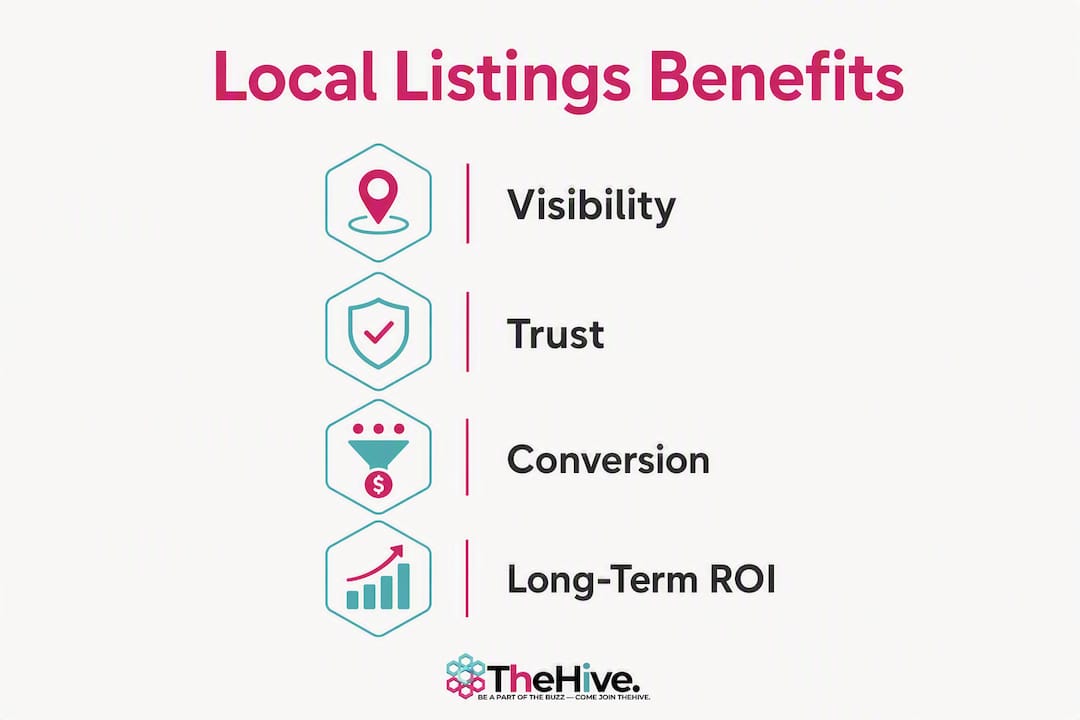
The business case for local listings runs through three stages: visibility, trust, and conversion. Each stage builds on the last.
Visibility: getting above the fold on mobile
More than 57% of local searches happen on mobile, and 46% of all Google searches carry local intent. On a phone screen, the Maps Pack takes up most of the visible area before a user scrolls. If your listing is not in that pack, you are effectively invisible to the majority of travelers searching in the moment. A complete, active Google Business Profile is the primary mechanism for getting there.
Trust: reviews, photos, and accurate hours
A listing with 40 reviews and 25 photos converts at a meaningfully higher rate than one with 3 reviews and a stock image. Travelers use listing pages to answer a simple question: "Is this real, and is it worth my time?" Up-to-date hours eliminate the friction of a phone call just to confirm you are open. Photos of the actual experience, not just a logo, answer the "is this worth it" question before the traveler even clicks through.

Conversion: fewer questions, more bookings
A well-built listing reduces the number of pre-booking questions your staff fields. When your hours, pricing hints, accessibility attributes, and booking link are all visible on the listing, travelers can self-qualify and book without a back-and-forth. That is time saved on your end and a faster path to revenue on theirs.
Long-term ROI that compounds
Local SEO provides a more consistent, long-term return because rankings accumulate over time, unlike paid ads that stop producing the moment you pause spending. A tourism business that builds strong listings in year one keeps benefiting from that work in year three. For seasonal businesses managing peak-season listings, that compounding effect is especially valuable.
How to claim, verify, and publish listings that convert
Follow this sequence for each platform. The steps are similar across Google Business Profile, TripAdvisor, Facebook, and Yelp, with platform-specific verification notes below.
- Search for your business on the platform before creating anything. Duplicate listings are the most common problem tourism operators face, and they dilute your ranking signals. If a listing already exists, claim it rather than creating a new one.
- Confirm your NAP is consistent across every listing. Your business name, address, and phone number must be character-for-character identical on every platform. "St." vs "Street" or a missing suite number is enough to confuse search algorithms.
- Choose your primary category carefully. On Google Business Profile, your primary category carries more weight than any other single field. Be as specific as the platform allows.
- Add your booking link before you publish. This is the step most operators skip, and it is the one that most directly connects listing traffic to revenue.
- Upload photos before going live. A listing published with zero photos gets fewer impressions than one with photos from day one.
- Verify the listing. Verification methods vary by platform and business type.
- Publish and monitor for the first 30 days.
Verification notes by platform:
- Google Business Profile: Most tourism businesses verify by postcard (5–7 business days) or phone/text. Instant verification is available if your business domain is already verified in Google Search Console. Service-area businesses (tour operators without a fixed storefront) can hide their address and still verify.
- TripAdvisor: Verification is typically by phone call or email to the business address on file. New listings can take 5–7 business days to go live after submission.
- Facebook: Business pages do not require formal verification to be active, but the blue verification badge requires submitting official business documents. For most tourism operators, an active, complete page is sufficient.
- Yelp: Claim via Yelp for Business Owners. Verification is by phone call to the number on the listing.
Common roadblocks and fixes:
- Duplicate listings: Report duplicates through each platform's support channel. On Google, use the "Suggest an edit" or "Report a problem" function on the duplicate listing.
- Service-area vs. address listing: If you operate tours from a launch point but do not have a storefront, set up a service-area listing on GBP and hide the address. Do not list a home address.
- Multi-location operators: Manage separate GBPs and destination pages for each distinct region. One centralized listing for a business operating in three cities will underperform in all three.
Pro Tip: If you are launching a new tourism business and need a step-by-step path to local discovery, the guide on getting discovered locally covers the full claiming and verification workflow with platform-specific screenshots.
Optimization tactics that increase bookings from listings
Claiming a listing is the floor, not the ceiling. The operators who consistently win bookings from their listings treat them like a landing page, not a form they filled out once.
Fields that directly influence bookings:
- Primary category: The single most important field on Google Business Profile. Choose the most specific category available, then add secondary categories.
- Attributes: Accessibility features, languages spoken, outdoor/indoor setting, and age-appropriateness all filter search results. Travelers with specific needs use these filters, and operators who fill them in capture that traffic.
- Service or product catalog: List each tour, package, or experience as a separate item with a short description and price range. This gives Google structured data to work with and gives travelers a reason to click.
- Booking URL: Link directly to your booking engine, not your homepage. Every extra click between "I want to book" and "I booked" costs you conversions. For small operators still choosing a system, a guide to online booking software for small businesses covers the main options.
- Q&A section: Seed your own Q&A with the three questions travelers ask most often. This content appears on your listing and can surface in search results.
Photo guidance:
Aim for a robust number of photos; a higher quantity is the benchmark for high-performing listings. Photograph the actual experience in action, not just the venue. Include at least one photo of your team, one of the physical setting, and one that shows the scale or atmosphere of the experience. Use descriptive file names before uploading (kayak-tour-windsor-essex.jpg, not IMG_4872.jpg). Captions are not required on most platforms, but adding them on TripAdvisor and Facebook improves context.
Short description templates:
- Tour operator: "[Tour name] offers [duration] [activity type] tours departing from [location]. Suitable for [age/skill level]. Book online or call [phone]."
- B&B / boutique accommodation: "[Property name] is a [room count]-room [style] property in [neighborhood/area], [X] minutes from [landmark]. Breakfast included. Direct booking available."
- Attraction: "[Attraction name] in [city] features [key draw]. Open [days/hours]. Tickets available at the door or online."
Pro Tip: Add a UTM parameter to your booking URL (e.g., ?utm_source=google&utm_medium=gbp) so you can track exactly how many bookings originate from each listing platform in Google Analytics or your booking software dashboard.
Managing listings at scale and measuring what is working
A listing you set up and forget will drift. Hours change, photos go stale, and competitors accumulate reviews while yours sit static. The operators who stay in the Maps Pack treat listing management as a recurring task, not a one-time project.
KPIs to track:
- Search impressions (how often your listing appears in results)
- Map impressions (how often your pin appears on the map)
- Clicks to website
- Calls from listing
- Direction requests
- Bookings attributed to listing traffic (via UTM parameters or booking software source tracking)
- Review volume and average rating
Monitoring cadence:
- Weekly: Check GBP for new reviews and respond within 48 hours. Responding to reviews signals engagement and authority to both algorithms and future guests. Check for any suggested edits from users that may have altered your listing.
- Monthly: Run a citation audit using a tool like BrightLocal or Whitespark to catch NAP inconsistencies across directories. Check photo performance in GBP Insights.
- Quarterly: Refresh photos, update seasonal hours, add new services or experiences to your catalog, and post at least one update or offer.
Timeline and cost estimates:
| Approach | Setup time | Monthly time | Estimated cost | When to expect results |
|---|---|---|---|---|
| DIY (owner-managed) | 4 hours | 1–2 hours | — | — |
| Managed listing service | 1–2 hours (onboarding) | Minimal | — | 30 days |
| Platform-assisted (e.g., Thehivewindsor) | Under 1 hour | Minimal | Subscription-based | Visibility from day one in local feed |
The DIY route works well for operators who have time and enjoy the process. Managed services make sense when you are running multiple locations or simply do not have bandwidth. Platform-assisted listing, where the platform itself surfaces your business to local searchers, compresses the timeline because you are not waiting for Google to index and rank a new listing from scratch.
Research-backed impact: what the data says about listings and local search
The case for local listings is not theoretical. Several consistent findings across local SEO research make the priority clear.
Citations and local listings rank as the 6th most significant factor for local pack visibility and tied for 4th for local organic search results. That is not a minor signal. It means that a tourism business with strong, consistent citations across authoritative directories has a structural ranking advantage over one that does not, independent of how good its website is.
GBP signals account for about 32% of local ranking factors, making it the single largest category in the ranking model. No other individual action you take in local SEO moves the needle as much as a complete, active Google Business Profile.
A significant portion of all Google searches carry local intent. For tourism queries specifically, that share is higher, because most tourism searches are inherently location-bound. "Whale watching tours," "historic walking tour," "bed and breakfast near me" all carry local intent by definition.
Business directories make up almost a third (31%) of local-intent organic search results in some studies. That means when a traveler searches for a tour or attraction in your area, nearly a third of what they see on the results page is directory listings, not websites. If your business is not in those directories, you are absent from a third of the search real estate.
High-value citation targets beyond the big four:
- State and regional tourism boards (e.g., your state's official tourism site)
- Local chambers of commerce
- Destination marketing organizations (DMOs)
- Regional travel blogs with high domain authority
- Local news sites that cover tourism and hospitality
Location-specific and government-backed citations carry stronger trust and link equity for local SEO in tourism than generic mass-market directories. A single listing on your state tourism board's site can outweigh ten generic directory entries in terms of ranking signal.
Why listings beat short-term ad spend for most tourism operators:
Paid search ads produce traffic while the budget is running. The moment you pause, the traffic stops. Local SEO provides a more consistent, long-term return because rankings compound over time. A tourism business that invests in listings and citations in its first year builds a digital footprint that keeps producing bookings in year two and three without additional spend. For operators with tight marketing budgets, that compounding dynamic makes listings the higher-ROI choice over the medium term.
For a deeper look at how local directories build trust signals over time, the mechanics are worth understanding before you decide where to focus your citation-building effort.
Key Takeaways
Tourism businesses that claim, optimize, and actively manage local listings on Google Business Profile, TripAdvisor, Facebook, and Yelp gain compounding visibility, trust, and direct bookings that paid ads alone cannot replicate.
| Point | Details |
|---|---|
| GBP is the top priority | GBP signals account for about 32% of local ranking factors — complete it first, before any other directory. |
| Maps Pack drives clicks | 42% of local clicks go to the Maps Pack; profile completeness is the primary lever for getting into it. |
| Citations build ranking trust | Local listings rank 6th for local pack visibility and tied 4th for local organic search results — consistency across directories matters. |
| Listings compound; ads don't | Local SEO rankings accumulate over time, delivering bookings long after the initial setup work is done. |
| Thehivewindsor for Windsor-Essex | Tourism operators in Windsor-Essex can list on Thehivewindsor for community-driven, review-ranked discovery with no pay-to-rank system. |
Why a locals-first listing strategy is the most durable play in tourism
Most tourism marketing advice focuses on reach: more impressions, bigger ad budgets, broader social campaigns. The operators I see consistently outperform their peers are doing something quieter. They are building a deep, accurate, well-reviewed presence in the specific places travelers look when they are ready to act.
The conventional wisdom treats local listings as a checkbox, something you do once and move on from. That is the wrong frame entirely. A listing is a live asset. It accumulates reviews, gets indexed for new search queries as you add services, and builds the kind of citation consistency that search algorithms interpret as trust. A tourism business with 80 reviews on Google and a complete profile in six authoritative directories is not just more visible than one with a bare-bones listing. It is structurally harder to displace.
The destination-first approach matters especially for multi-location operators. Running a single GBP for a business that operates tours in three different cities is a slow way to be mediocre in all three. Separate listings, separate landing pages, separate review strategies per location: that is what actually moves the needle. A destination-first architecture captures both pre-trip research and in-destination discovery while preventing the duplicate-content penalties that centralized pages create.
One more thing that gets underestimated: the review response. Operators who respond to every review, not just the bad ones, signal to both the algorithm and future guests that the business is actively managed. That signal is worth more than most operators realize, and it costs nothing but a few minutes a week.
Thehivewindsor gives Windsor-Essex tourism businesses a different kind of visibility
Paid ranking is the default on most platforms. The business that spends the most shows up first, regardless of quality. Thehivewindsor works the opposite way: your listing rises based on the reviews and community engagement you earn, not the ad budget you set.
For tourism operators in Windsor-Essex, that means a kayak outfitter with 40 genuine reviews and an active listing will consistently outrank a competitor who simply pays for placement. The platform includes map-based zone search so travelers can find experiences by neighborhood or area, direct booking links on every listing, event listings for seasonal programming, and a community feed that keeps your business visible between bookings.
Getting listed takes under an hour. Your profile includes your business description, photos, service catalog, booking link, and review display from day one. The local visibility best practices built into the platform are designed specifically for Windsor-Essex operators, not generic national templates.
Tours, B&Bs, attractions, and seasonal hospitality businesses in the region are the exact operators Thehivewindsor was built for. Claim your listing on Thehivewindsor and put your business in front of the travelers and locals already searching the platform today.
Useful sources and further reading
The findings in this article draw from a consistent body of local SEO research. These are the primary sources worth bookmarking for ongoing reference:
- The Role of Business Listings in Local SEO — Moz: The clearest plain-language explanation of what listings are, how NAP consistency works, and why listings function as a ranking signal. Start here if you want to understand the mechanics before diving into platform-specific tactics.
- Benefits of Local SEO in 2026 — Arc4: Source for the 46% local intent and 57% mobile search figures, plus the compounding ROI argument for listings over paid ads.
A note on using these resources: BrightLocal and Whitespark are the most practical tools for running citation audits and finding NAP inconsistencies at scale. Moz's local SEO guides are the best starting point for understanding ranking mechanics. For tourism-specific citation targets, your state's official tourism board and regional DMO are higher-value than any generic directory, and both are worth pursuing before you spend time on mass-market submissions.