

Local directories are online platforms that list businesses by location, and they are the single most underused growth tool available to small-town entrepreneurs. Understanding why local directories matter in small towns starts with one fact: 46% of online searches are for local information. That number means your next customer is already searching. The question is whether your business shows up when they do. Platforms like Thehivewindsor are built specifically to solve that problem for communities like Windsor-Essex.
Why local directories matter in small towns more than anywhere else
Small towns face a visibility problem that big cities do not. A bakery in a metro area benefits from foot traffic, transit ads, and dense competition that keeps the category top of mind. A bakery in a small town has none of that. Local directories fill that gap by putting businesses in front of people who are actively looking for them.
31% of top 10 organic local search results are business directories. That means directories are not a secondary channel. They are core infrastructure for how search engines surface local businesses. If your business is not listed, you are invisible to a third of the most valuable search real estate available.

The importance of local directories also extends beyond Google. New residents, visiting family members, and local investors all turn to directories when they want to understand what a community offers. A well-maintained listing tells those people your business exists, is active, and is worth visiting.
How accurate listings improve your search visibility
The technical term for your business name, address, and phone number appearing consistently across the web is NAP data. NAP consistency is the most critical technical factor for local search success. Even minor differences, like writing "St." in one place and "Street" in another, cause ranking weakness that pushes your business down in search results.
The payoff for getting this right is significant. Maintaining consistent NAP data across 40 or more authoritative directories improves local search rankings by 53% and can boost Google Maps visibility by up to 156% within 90 days. For a small-town business, that kind of lift can mean the difference between a slow week and a full calendar.
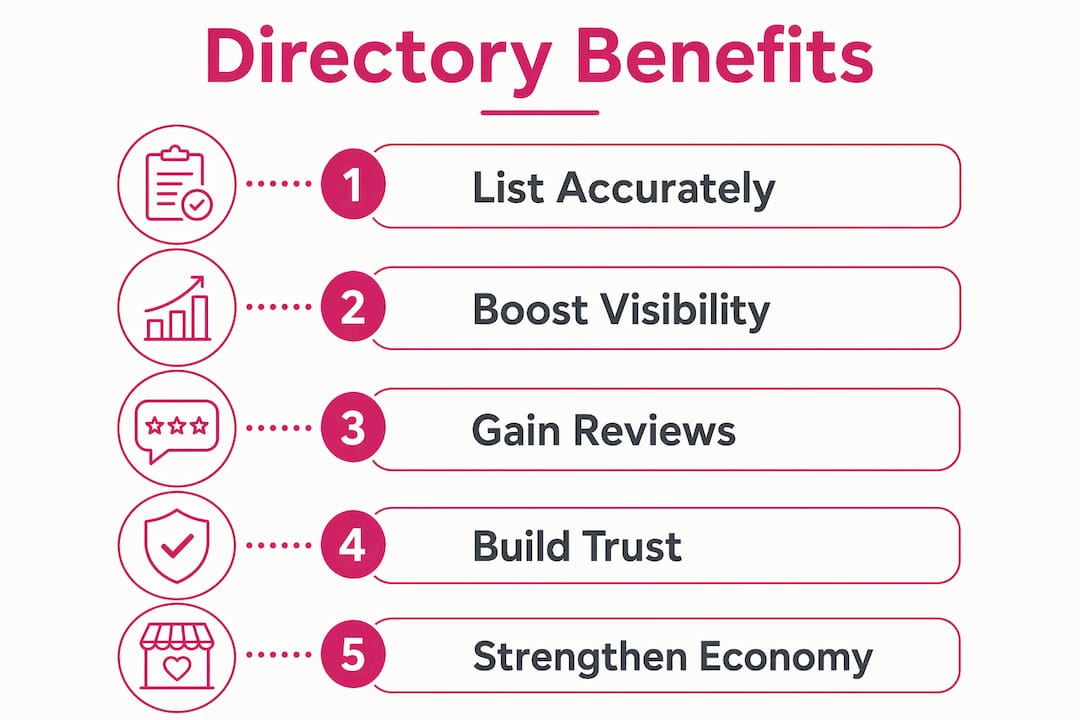
Local search also rewards businesses that appear in the Map Pack, the three business listings that appear at the top of Google search results with a map. 68% of consumers prefer Map Pack results over standard organic links. Top Map Pack businesses average 561 reviews with 4.8-star ratings. Each 10 new reviews can boost conversion by 2.8%.
The primary SEO benefit of directory listings in 2026 is geographic validation. Search engine AI systems use directory data to confirm that your business physically exists at a real location. That confirmation is now more important than traditional backlink authority for appearing in Map Packs and local AI-generated answers.
- Confirm your business name, address, and phone number are identical across every listing.
- Check that your hours, website URL, and category tags match on all platforms.
- Run a quarterly audit to catch any drift caused by platform auto-corrections or outdated entries.
Pro Tip: Set a recurring calendar reminder every three months to check your top five directory listings. Catching one "St." vs. "Street" discrepancy can recover rankings you did not even know you lost.
How directories build trust in small-town communities
Trust is the currency of small-town commerce. Customers in smaller communities rely on word of mouth and community reputation far more than customers in cities. Local directories, especially those hosted by Chambers of Commerce or community organizations, act as trust-building engines by providing third-party validation that reduces the perceived risk of trying a new business.
The mechanism is called prestige transfer. When a trusted institution like a Chamber of Commerce lists your business, some of that institution's credibility attaches to your brand. Customers who might hesitate to try an unfamiliar business feel more confident because a known community organization has effectively vouched for you. Membership requirements and vetting processes reinforce that signal.
Community directories also humanize businesses in ways that a plain Google listing cannot. A well-built directory profile includes:
- A business bio that tells your story and connects you to the community.
- Photos that show your space, products, or team.
- Customer reviews that reflect real local experiences.
- Featured listing or "Community Favorite" designations that signal peer recognition.
"A directory listing is not just a citation. It is a community endorsement. When your neighbors see your business listed alongside organizations they already trust, they extend that trust to you."
Online directories also make it easier for customers to find your contact information and leave reviews. Accurate directory listings increase the chances of positive local customer interactions by reducing friction at every step of the discovery process.
Why directories strengthen local economies in small towns
Local directories function as a digital town square. They centralize information that used to live in printed phone books, community bulletin boards, and local newspapers. As many small towns lose local news coverage, directories fill the gap by serving as trusted information hubs that sustain community awareness and economic activity.
The economic impact goes beyond individual businesses. Directories serve as a coordination layer that makes the entire local economy more discoverable. New residents use them to find services. Investors use them to assess what a community offers. Workforce recruits use them to understand whether a town has the amenities they need. Accurate listings in directories help economic clusters form and strengthen regional competitiveness.
Here is how small towns can use directories to build economic resilience:
- Centralize local events. A directory with a shared calendar keeps residents informed about markets, festivals, and business openings, which drives foot traffic to multiple businesses at once.
- Highlight new businesses. Featured listings for new arrivals help them build awareness faster and reduce the failure rate in the critical first year.
- Support shop-local campaigns. A directory that groups businesses by neighborhood or category makes it easy for residents to choose local options over online retailers.
- Connect businesses to each other. Directories that include supplier and service provider listings help local businesses source locally, keeping more money circulating within the community.
- Attract outside visitors. A well-maintained community directory functions as a visitor guide, turning curious travelers into paying customers.
Best practices for getting the most from directory listings
The biggest mistake small-town business owners make with directories is treating them as a one-time task. A listing you set up two years ago and never updated is actively hurting you. Outdated hours, wrong phone numbers, and missing photos all reduce the trust signals that directories are supposed to generate.
Quality beats quantity every time. Submitting to 30–50 high-authority, relevant directories is far more effective than blasting your information to hundreds of low-quality sites. Mass submissions to what the industry calls "digital landfill" directories dilute your NAP consistency and weaken your local search authority.
- Choose directories that are specific to your region, your industry, or both.
- Complete every field in your profile, including photos, business description, and hours.
- Respond to every customer review, positive or negative, within 48 hours.
- Add seasonal promotions or special offers when your directory platform supports them.
- Monitor your listings monthly for unauthorized edits or duplicate entries.
Pro Tip: When you claim a listing on any directory, immediately set a strong password and enable any available account alerts. Duplicate or hijacked listings are a real problem, and catching them early prevents months of ranking damage.
Key takeaways
Local directories are the most cost-effective visibility tool available to small-town businesses, combining local SEO impact, community trust, and economic coordination in a single channel.
| Point | Details |
|---|---|
| NAP consistency drives rankings | Consistent name, address, and phone data across directories can improve local search rankings by 53%. |
| Map Pack visibility is critical | 68% of consumers prefer Map Pack results, making directory-backed geographic validation a top priority. |
| Trust transfers from host to business | Listings in Chamber of Commerce and community directories carry credibility that reduces consumer hesitation. |
| Directories support the whole economy | Centralized listings help new residents, investors, and visitors discover what a small town offers. |
| Quality listings beat quantity | Focus on 30–50 authoritative, relevant directories rather than mass submissions to protect NAP consistency. |
What I have learned watching small towns go digital
I have watched a lot of small-town business owners treat their online presence as an afterthought. They pour energy into their physical space, their product, their service, and then assume customers will find them. That assumption made sense 20 years ago. It does not hold up now.
What surprises most business owners when they finally audit their directory presence is how much damage has already been done by neglect. Wrong phone numbers. Closed hours listed as open. No photos. No reviews. These are not minor issues. They are the digital equivalent of a dark storefront with a hand-written "maybe open" sign in the window.
The other thing I have noticed is that small towns have a genuine advantage here that they rarely use. Community trust is higher in small towns. When a local directory carries the weight of a trusted community institution, that trust transfers to every business listed there. That is a competitive edge that no big-city business can replicate. The businesses that recognize this and invest in their directory presence early are the ones that build durable customer relationships, not just one-time visits. Prioritizing your local directory presence in 2026 is not optional. It is the foundation everything else builds on.
— randy
Thehivewindsor is built for businesses like yours
Windsor-Essex small business owners now have a local discovery platform that works the way a community directory should. Thehivewindsor lists businesses based on the reviews and community support they earn, not on ad spend. That means a 40-year-old family shop and a brand-new side hustle compete on equal footing.
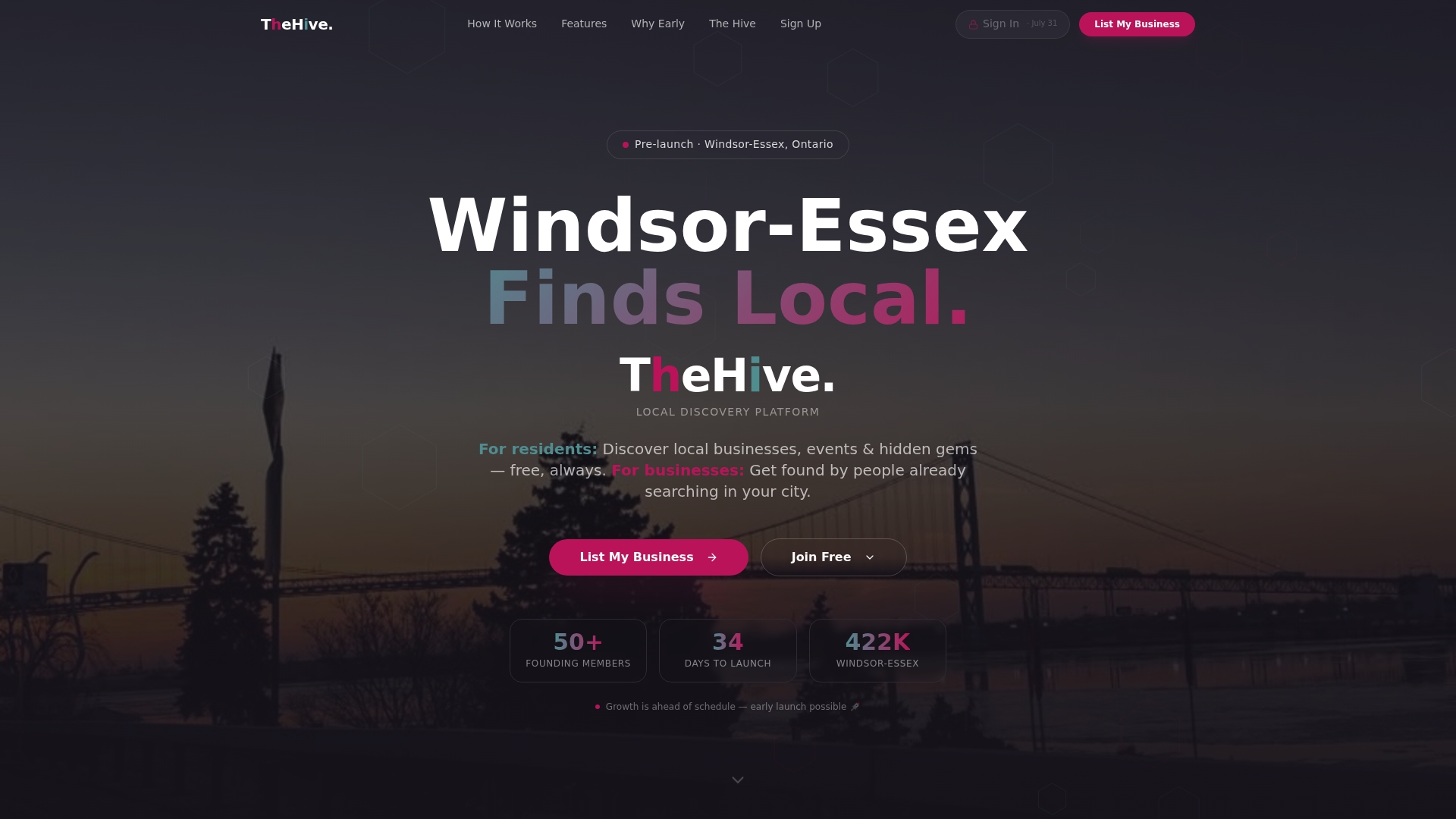
Thehivewindsor brings together business listings, community events, and local discovery in one place so residents never have to jump between apps to find what Windsor-Essex offers. The platform's review-driven ranking system gives every business a fair shot at visibility. Whether you are a hobbyist turning a passion into income or a established local brand, claiming your listing puts your business in front of the people already looking for what you offer.
FAQ
Why do local directories matter for small-town businesses?
Local directories put small-town businesses in front of customers who are actively searching for local options. Since 46% of online searches are for local information, a directory listing is one of the most direct ways to capture that demand.
What is NAP data and why does it matter?
NAP stands for Name, Address, and Phone number. Consistent NAP data across directories improves local search rankings and confirms your business location to search engine AI systems, which is the primary factor for Map Pack inclusion in 2026.
How many directories should a small business list on?
Focus on 30–50 high-authority, relevant directories rather than submitting to every available site. Mass submissions to low-quality directories dilute NAP consistency and weaken local search authority.
Do Chamber of Commerce directories actually help?
Yes. Chamber of Commerce directories provide third-party validation that reduces consumer hesitation. Businesses listed in trusted community directories benefit from prestige transfer, meaning customers extend the institution's credibility to the listed business.
How often should I audit my directory listings?
Quarterly audits are the recommended standard. Even minor inconsistencies like "St." versus "Street" can cause local SEO ranking drops, so regular checks prevent small errors from compounding into significant visibility losses.