

A suburban local marketplace is a place-bound, multi-merchant digital platform where Windsor‑Essex residents discover nearby businesses, events, and services in one shared space, without jumping between apps or scrolling past irrelevant national results. Three things happen when it works well: you find a same-day repair shop two neighborhoods over, RSVP to a weekend pop-up market, and spend money that actually stays in Windsor‑Essex. Local spending on community platforms tends to recirculate locally at a far higher rate than purchases routed through national platforms. Thehivewindsor is the local example built around exactly this model, and the rest of this guide explains how it all fits together.
- Discover nearby businesses, events, and services in one place
- Get same-day pickup or local delivery options
- Support the local economy by keeping spend close to home
Table of Contents
- What counts as a suburban local marketplace?
- Why does this matter for Windsor‑Essex residents?
- What core features should you expect from a local marketplace?
- How do Windsor‑Essex residents actually use a local marketplace?
- Why should Windsor‑Essex businesses join a suburban marketplace?
- How do you choose the right local marketplace for Windsor‑Essex?
- What do listings typically cost on a suburban local marketplace?
- What mistakes should you avoid when launching or joining a local marketplace?
- How does Thehivewindsor work as a local example?
- What about user privacy and data security?
- How do local marketplaces support community beyond commerce?
- How do suburban marketplaces relate to larger regional platforms?
- Key Takeaways
- Why the "community-first" framing is the only one that holds up
- Thehivewindsor is Windsor‑Essex's local discovery platform
- Useful sources
What counts as a suburban local marketplace?
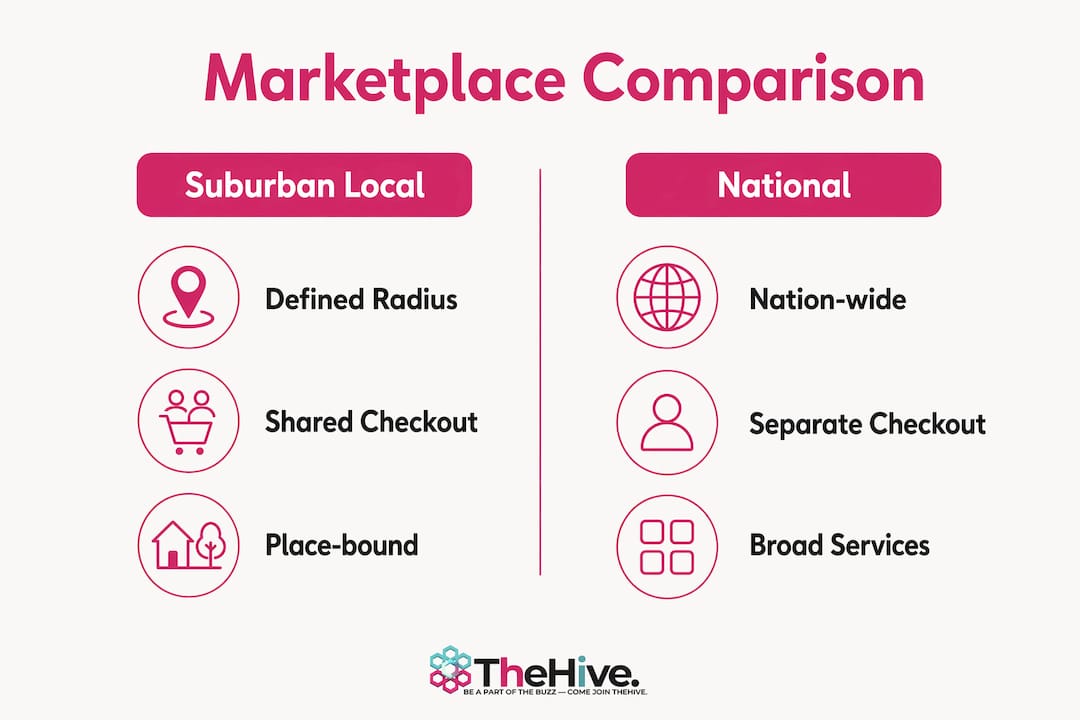
A platform earns the label when it meets four criteria: a defined geographic buyer radius, multi-merchant shared checkout, fulfillment structured around proximity (pickup, same-day, or local courier), and a civic orientation that goes beyond generic listings. Local marketplace features center on geographic buyer filtering and proximity-based fulfillment, not just having local sellers on a national platform.
| Dimension | Suburban local marketplace | National marketplace | Social network / P2P listing |
|---|---|---|---|
| Geographic scope | Defined radius or neighborhood | Country-wide with local filters | Varies, often city-wide |
| Merchant onboarding | Structured, with local support | Self-serve, minimal local context | Informal, no onboarding |
| Fulfillment | Pickup, same-day, local courier | National shipping | Buyer arranges pickup |
| Fee structure | Low take rate (commonly 3–8%) | High take rate (15–45%) | Usually free or minimal |
| Civic orientation | Community events, local news | None | Minimal |
Place-bound services like plumbers, repair shops, and fitness studios fit naturally because they serve a defined suburban radius. Remote consultancies do not, even if the owner lives locally.
Why does this matter for Windsor‑Essex residents?
Windsor‑Essex sits in a geographic position that makes a dedicated suburban platform genuinely useful. The region spans lower-density neighborhoods, smaller commercial corridors, and a wide last-mile distance between communities like Amherstburg, Tecumseh, and LaSalle. A national marketplace treats all of that as one undifferentiated blob. A suburban platform maps it correctly.
The practical benefits show up fast:
- Find a same-day appliance repair in your own postal code instead of waiting three days for a national service
- Discover a neighborhood farmers market or weekend pop-up that never appears on a national events app
- RSVP to a local fitness class or community workshop with one tap
- Resolve a return or dispute in person rather than through a call center
Peer-to-peer marketplace research shows that platforms structured around local trade reduce small-business failure risk and lower operating costs for merchants in the affected region. For Windsor‑Essex, that means fewer empty storefronts and more reasons to stay local.
What core features should you expect from a local marketplace?
Location-based discovery and map integration are foundational. A platform without neighborhood-level filtering is just a directory. Here is what a well-built suburban marketplace includes:
- Location-based search and maps: filter by neighborhood, postal code, or distance
- Merchant profiles: hours, inventory, photos, and contact options in one place
- Shared cart and checkout: buy from multiple local merchants in one transaction
- Events listing and RSVP: community classes, pop-ups, markets, and local news
- Community reviews and ratings: ranked by genuine feedback, not ad spend
- Buyer-seller messaging: direct contact before committing to a purchase or booking
- Local pickup and same-day delivery: the core competitive edge over national platforms
- Saved lists and neighborhood watchlists: reduce friction for repeat trips and multi-stop pickups
Same-day pickup is where suburban platforms beat national players outright. A package from a national retailer takes days; a local merchant two kilometers away can have it ready in an hour.
Trust features matter too. Verification badges, clear moderation policies, and explicit privacy controls tell you whether the platform takes community safety seriously or treats it as an afterthought.

How do Windsor‑Essex residents actually use a local marketplace?
The flow is straightforward once you know it:
- Discover the platform through a local social group, word of mouth, or a search for Windsor‑Essex businesses
- Set your location and neighborhood so results reflect your actual radius
- Browse by category or map view to find merchants, services, or upcoming events
- Save favorites for repeat visits or weekly shopping runs
- Message the merchant or RSVP to confirm availability, hours, or event details
- Select pickup or delivery based on what the merchant offers
- Complete checkout and collect your order locally, often the same day
Pro Tip: Set up neighborhood alerts and save a recurring shopping list. Multi-stop pickups become a single coordinated trip instead of three separate errands.
Before you interact with any platform, check the privacy settings. Control what location data you share, review how your purchase history is used, and confirm that the review system is moderated rather than open to manipulation.
Why should Windsor‑Essex businesses join a suburban marketplace?
The economics favor local merchants in ways national platforms do not. Hyperlocal transactions remove courier charges and reduce seller overhead when buyers pick up locally, which means better margins without raising prices.
Key benefits for local businesses, creators, and event organizers:
- Higher discoverability among motivated nearby customers who are already looking to buy local
- Lower fulfillment overhead when pickup replaces long-haul shipping
- Stronger repeat visit rates to physical storefronts
- Access to local business discovery tools that surface new merchants to neighborhood audiences
A short owner checklist to get started: create a complete profile with photos, set pickup and delivery windows, respond to every review within 48 hours, and list upcoming events or promotions. Track orders per week and returning-customer rates after 30 days to see whether the platform is working.
How do you choose the right local marketplace for Windsor‑Essex?
Marketing claims are easy to make. These questions cut through them:
- Is my neighborhood actually covered, or does the platform only serve the urban core?
- What are the fulfillment options, and who handles last-mile logistics?
- Is the fee structure published clearly, or does it appear only after signup?
- How are disputes and returns handled?
- What data does the platform collect, and how is it used?
Red flags to watch for: Heavy paid ranking that buries unsponsored merchants. Murky fees that change after onboarding. Weak local support with no real merchant contact. Rushed expansion into multiple cities before the home market has reliable fulfillment. Any of these signals that the platform is optimizing for growth metrics, not community outcomes.
Platforms with local partnerships, such as business improvement districts or chambers of commerce, tend to have stronger accountability. That civic alignment is a meaningful trust signal.
What do listings typically cost on a suburban local marketplace?
Common pricing models and their trade-offs:
- Free listings with premium placement: low barrier to entry; revenue comes from optional upgrades
- Subscription tiers: predictable monthly cost for merchants; platform revenue is stable
- Percentage take rate per transaction: aligns platform incentives with merchant sales
- Flat per-listing fees: simple but can discourage high-volume merchants
- Local advertising or placement fees: only acceptable when clearly disclosed and not the primary ranking signal
| Model | Merchant cost | Platform revenue | Best for |
|---|---|---|---|
| Free + premium placement | Low to none | Upsell conversions | New or small merchants |
| Subscription tier | Fixed monthly fee | Predictable | Established local businesses |
| Transaction take rate | a generally lower percentage locally compared to nationally | Scales with GMV | High-volume merchants |
| Flat per-listing | Per item | Simple | Low-volume sellers |
National marketplaces charge 15–45% of GMV; local platforms commonly target the 3–8% range. That gap is where local merchant margins live.
What mistakes should you avoid when launching or joining a local marketplace?
The most common failure is scaling too fast. A platform that launches in Windsor, then immediately expands to Toronto and London, Ontario before Windsor has reliable fulfillment and a dense merchant network is not building a local marketplace. It is building a thin directory.
"Patience is a competitive weapon. Local marketplaces often fail because they try to scale too fast instead of building local density first. Build depth in one metro before expanding." — ShopAppy on local marketplace success
Other common mistakes:
- Prioritizing selection breadth over fulfillment reliability
- Neglecting merchant onboarding so new listings are incomplete and hard to find
- Over-relying on advertising instead of building community trust through reviews and storytelling
Embedding local stories and civic identity strengthens participation more reliably than ad campaigns. A hyperlocal strategy built on community empathy and deep local engagement outperforms aggressive user-count growth in suburban markets every time.
How does Thehivewindsor work as a local example?
Thehivewindsor is Windsor‑Essex's ad-spend-free local discovery platform. The listing algorithm ranks merchants by reviews and community signals, not by who paid for placement. That means a 40-year-old family business and a hobbyist selling handmade goods compete on the same terms: the quality of their work and the feedback they earn.
How it works:
- Merchant profiles include hours, inventory, photos, and fulfillment options
- Event listings cover community classes, pop-ups, markets, and neighborhood news
- Community reviews drive rankings, with moderation to keep feedback genuine
- Local pickup and delivery routing connects buyers to nearby merchants efficiently
- One platform replaces the need to check multiple apps or sites for Windsor‑Essex information
Getting listed on Thehivewindsor:
- Create a profile at thehivewindsor.com
- Add inventory, photos, and business hours
- Set your pickup and delivery options
- Follow the platform's moderation guidelines
- Invite existing customers to leave reviews
For Windsor‑Essex businesses, community-based commerce on a platform like this means visibility without an ad budget.
What about user privacy and data security?
Suburban local marketplaces collect more granular location data than national platforms because proximity is the core product. That makes privacy practices more consequential, not less. Before joining any platform, check what location data is retained, whether purchase history is sold to third parties, and how the review system is moderated against fake or retaliatory feedback.
Good platforms publish a clear privacy policy, let users control location-sharing granularity, and moderate reviews with a transparent appeals process. Platforms that obscure these details are worth avoiding regardless of how good the merchant selection looks.
How do local marketplaces support community beyond commerce?
The best suburban platforms do more than connect buyers and sellers. They become the connective tissue for neighborhood life: local news feeds, community event calendars, neighborhood group boards, and small-business spotlights that would never surface on a national platform.
In Windsor‑Essex, that means a platform can host the announcement for a Tecumseh community cleanup, list a LaSalle fitness studio's new class schedule, and surface a downtown Windsor pop-up market, all in one place. Local directories that go beyond commerce build the kind of daily habit that keeps residents returning. When a platform becomes the place you check for what is happening this weekend, it has earned a different kind of loyalty than any ad campaign can buy.
How do suburban marketplaces relate to larger regional platforms?
A suburban local marketplace is not trying to replace a regional or urban platform. It fills a different gap. Urban platforms optimize for density and volume. Suburban platforms optimize for proximity and community fit.
Windsor‑Essex residents who commute to Detroit or Toronto may use those cities' platforms for work-related purchases. But for same-day needs, local events, and community services, a Windsor‑Essex-specific platform surfaces results that a Detroit-centric or Toronto-centric platform will never prioritize. The two can coexist because they serve different jobs. Where suburban platforms run into trouble is when they try to replicate the breadth of a regional platform before they have built the local density that makes proximity fulfillment actually work.
Key Takeaways
A suburban local marketplace succeeds when it builds dense merchant networks and community trust within a defined geographic area before attempting any expansion.
| Point | Details |
|---|---|
| Core definition | A place-bound, multi-merchant digital platform built around proximity, local fulfillment, and community identity. |
| Fee advantage | Local platforms commonly target 3–8% take rates versus 15–45% on national marketplaces, leaving more margin for local merchants. |
| Scale deep, not wide | Building dense merchant and user networks in one area before expanding is the proven path to sustainable local marketplace success. |
| Privacy matters | Check location data retention, third-party data sharing, and review moderation before joining or listing on any platform. |
| Thehivewindsor | Windsor‑Essex's ad-spend-free discovery platform ranks merchants by community reviews, not paid placement, covering businesses of every size. |
Why the "community-first" framing is the only one that holds up
Most local marketplace pitches lead with technology. Faster delivery, smarter search, better maps. Those features matter, but they are not why suburban platforms succeed or fail. The ones that last are the ones that earn genuine trust from the people who live there.
Windsor‑Essex is not a test market. It is a community with its own rhythms, its own main streets, and its own reasons for choosing one business over another. A platform that treats it as a geographic filter on a national database will always feel hollow to the people who actually live here. The platforms that work are the ones that show up for the community first and worry about scaling second. That is not a feel-good principle. It is the operational reality that the evidence keeps confirming.
Thehivewindsor is Windsor‑Essex's local discovery platform
Windsor‑Essex residents and business owners have one place to find and be found without paying for placement: Thehivewindsor. The ranking algorithm runs entirely on community reviews and local signals, which means a new boutique in Amherstburg gets the same fair shot as a business that has been on the main street for decades.
Whether you are a hobbyist selling handmade goods on weekends, a startup looking for your first local customers, or an established business that wants to stop paying national platform fees for local traffic, Thehivewindsor consolidates everything Windsor‑Essex in one place. No ad budget required. Explore listings or create your merchant profile today, and check the platform features to see what tools are available for your business.
Useful sources
- theHive Windsor‑Essex Local Discovery Platform
- Community-Based Commerce Explained for Local Entrepreneurs — The Hive blog
- How New Businesses Get Discovered Locally in 2026 — The Hive blog
- List Local Business Windsor Essex: 2026 Discovery Guide — The Hive blog
- Local marketplaces explained — ShopAppy
- Local marketplaces succeed — ShopAppy
- How to build a marketplace for local products — Sharetribe
- Developing a hyperlocal commerce strategy — CloudBusinessIdeas
- Peer-to-peer marketplaces and local business impact — Academy of Management Proceedings (2025)
- Why hyperlocal marketplaces offer better deals — IndClassifieds
- Local storytelling strengthens marketplaces — UPY journal