

Authentic local search is the practice of earning visibility in Google Maps, the Local Pack, and AI answer engines through verified, real-world signals: accurate business information, genuine customer reviews, and ongoing community activity, rather than through paid placement or generic keyword tricks. Search systems now weight trust over polish, and AI-driven answer engines are even less forgiving of thin or templated local pages than traditional rankings ever were. If you own or manage a small business and do nothing else after reading this, do this: claim and fully verify your Google Business Profile (GBP) today. It's the single largest lever you control, and every other authenticity signal builds on top of it.
Here's the fast version of what matters before you dig into the mechanics:
- Your GBP listing needs to be claimed, verified, and complete with real hours, photos, and services.
- Reviews should be current, responded to, and honest, not purchased or incentivized.
- Your business name, address, and phone number (NAP) must match exactly across every directory.
- Content about your business should mention actual neighborhood details, not generic city-name templates.
Pro Tip: Search Google for your own business name right now. If your hours, address, or phone number differ between Google, Facebook, and your website, fix that mismatch before you do anything else. It's the cheapest, fastest authenticity fix available.
Key Takeaways
Authentic local search rewards verified, community-rooted signals like consistent NAP, real reviews, and complete GBP profiles over generic templates or paid placement.
| Point | Details |
|---|---|
| Start with GBP | Claim and fully verify your Google Business Profile before any other local search work. |
| Fix NAP first | Audit your name, address, and phone number across every directory and correct mismatches immediately. |
| Reviews build trust fastest | Ask every customer for a review and respond to all of them within days, not weeks. |
| Write real neighborhood detail | Replace templated city-name pages with specifics only your business could claim. |
| Expect months, not days | Sustained authenticity gains take three to six months; GBP fixes show results in weeks. |
Table of Contents
- What Is Local Search and What Does It Include?
- What Makes Local Search Genuinely Authentic?
- How Does Local Search Actually Work?
- What's the Fastest Way to Improve Local Search Visibility?
- How Long Does It Take to See Local Search Results?
- Which Metrics Actually Matter for Local Search?
- What Common Mistakes Undermine Local Search Authenticity?
- How Does a Community-Driven Listing Model Improve Authenticity?
- Why Authenticity Should Be Your Long-Term Local Strategy
- Where to Learn More About Local Search
- Frequently Asked Questions
- Sources
What Is Local Search and What Does It Include?
Local search covers any query tied to a physical location or service area, and it runs on a handful of interconnected systems: Google Business Profile, Google Maps, the Local Pack, Local Finder, Apple Maps, and Bing Places, plus the directories and review platforms that feed data into all of them. When someone searches "plumber near me," those platforms cross-reference structured business databases to surface results tied to the searcher's location, according to Wikipedia's overview of local search).
Local intent splits into two categories, and the distinction matters more than most business owners realize. Explicit local intent shows up as a location modifier in the query itself, like "dentist near me" or "coffee shop in Windsor." Implicit local intent has no location word at all, but the search engine infers it anyway, the same source notes. Someone typing "how to fix a leaky faucet" gets local plumber ads and map results because Google assumes a service need, not a DIY tutorial, unless the wording clearly signals otherwise.
These pieces work together to produce what you actually see on a results page. Google Maps supplies the geographic layer. The Local Pack (the three-listing box with a map that appears above organic results) pulls from GBP data. The Local Finder is the expanded version you reach by clicking "more places." Apple Maps and Bing Places run parallel systems that matter more than people assume, especially for iPhone users defaulting to Siri and Apple Maps for "near me" queries. Miss one of these platforms, and you've created a gap in your coverage that a competitor with a completed profile will fill instead.
- Google Business Profile: the primary data source for Google's map and pack results.
- Google Maps and the Local Pack: where most map-based discovery happens.
- Local Finder: the expanded results view for deeper comparison shopping.
- Apple Maps and Bing Places: parallel ecosystems many businesses ignore entirely.
- Directories and review platforms: secondary sources that reinforce or undercut your core listings.
Pro Tip: Check your business on Bing Places and Apple Maps Connect even if you've never touched them. Both are free to claim, and an unclaimed or wrong-information listing there is invisible ground you're giving away to zero effort on a competitor's part.
What Makes Local Search Genuinely Authentic?
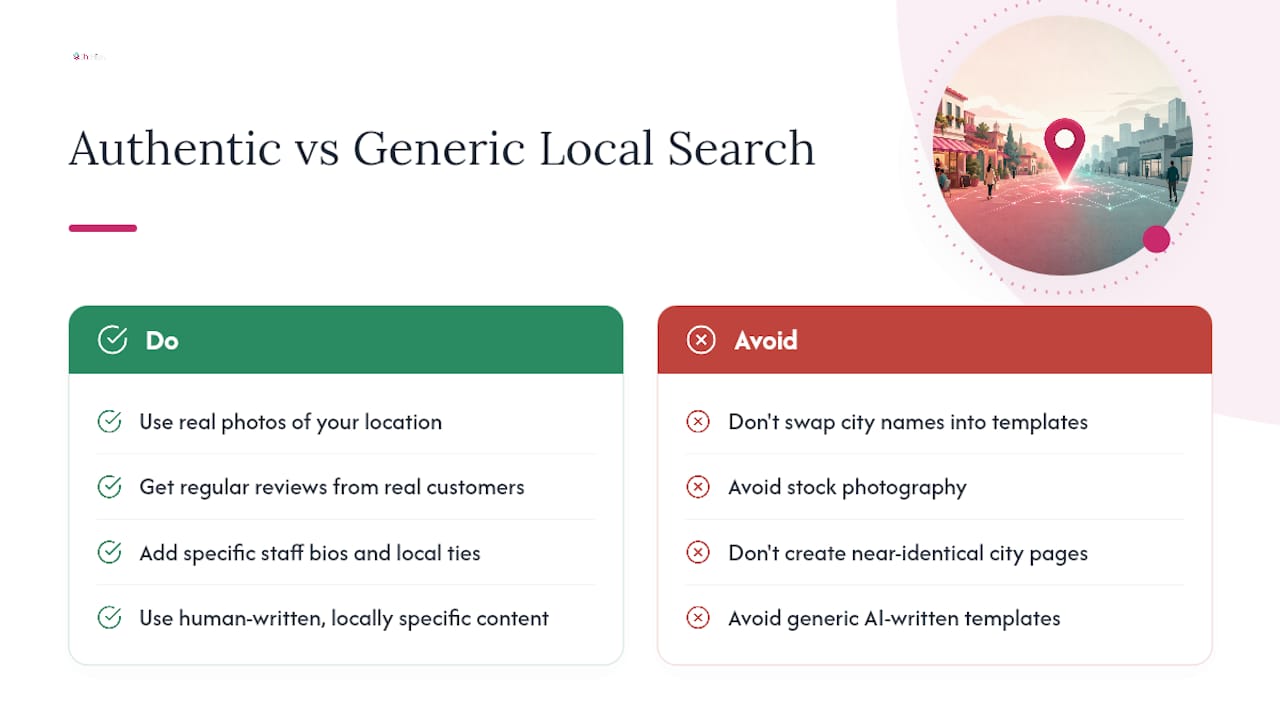
Authentic local search means your online presence reflects operational reality: real photos taken at your actual location, reviews that arrive steadily from actual customers, and content that references specifics only someone who has actually worked there would know. It differs from generic localization in one clear way: swapping a city name into a templated page is not the same as writing about your specific neighborhood, your actual staff, or the parking situation your customers deal with every day.
Search systems increasingly reward businesses that display genuine local relevance, meaning real reviews, verified operational details, and community-engaged content, over generic or paid signals, based on Semrush's analysis of local SEO ranking factors. Chamber of Commerce](https://www.uschamber.com/co/grow/marketing/local-seo-benefits-for-small-businesses).
The contrast plays out in specific, checkable details. A landscaping company with authentic signals posts photos of the actual crew working an actual yard this week, has a staff bio mentioning the owner grew up two towns over, and gets a new review every few days that mentions a real job by name. A landscaping company running weak localization has stock photography, a "Serving [City Name] Since [Year]" header repeated across ten near-identical city pages, and a review count frozen at 12 for the past two years.
Businesses with ongoing community interactions and transparent operations are consistently chosen more often in high-intent local searches than those relying on generic listings, per the U.S. Chamber of Commerce.
Human-led content that references neighborhood landmarks, staff names, and operational specifics keeps outperforming generic AI-written templates for local queries, largely because it supplies the "local truth" that both people and search systems rely on, as Local Falcon's research on authenticity in the AI era points out. An inauthentic snippet reads like "We provide quality plumbing services throughout the [city] area." An authentic one reads like "We've fixed frozen pipes in half the older homes on Riverside Drive, most built before 1960 with the same outdated shutoff valves."
Pro Tip: Read your own "About" page and location pages out loud. If the sentence could be copy-pasted onto a competitor's site in a different city with just the name swapped, rewrite it with a detail only your business could claim.
How Does Local Search Actually Work?
Local search ranking comes down to three pillars: relevance, distance, and prominence, and every ranking factor you can influence feeds into one of those three. Relevance measures how well your business matches what the searcher wants. Distance measures physical proximity to the searcher or the searched location. Prominence measures how well known and well regarded your business is, both online and off, per Semrush's breakdown of local SEO fundamentals.
Google, Bing, and Apple all treat your business attributes as entity data, not decoration. When you fill out categories, services, hours, and attributes in your GBP, you're feeding structured information the search engine can match against a query with precision. A profile with three photos and no listed services gives the algorithm almost nothing to match. A complete profile with 40 photos, five service categories, and accurate hours gives it dozens of matching points.
Reviews, citations, and consistent NAP data (your business name, address, and phone number) function as trust reinforcement. Local SEO tactics that combine on-site content, GBP completeness, citation accuracy, and review volume remain the foundation of local visibility, and GBP itself remains the cornerstone every other tactic supports, Moz's guide to local search marketing notes. A local backlink from a chamber of commerce or a community organization carries more weight than a generic directory listing because it signals real community ties, not just a database entry.
A short glossary helps here, because the jargon trips up even experienced marketers:
- GBP (Google Business Profile): your free, claimable business listing that powers Google Maps and the Local Pack.
- Local Pack: the three-result map box that appears above organic results for local queries.
- Local Finder: the expanded list you reach by clicking "more places" in the Local Pack.
- Schema markup: structured code on your website that tells search engines exactly what your business is, where it's located, and what it offers.
- Entity signals: the combined data points (name, address, category, hours, reviews) that let a search engine treat your business as a verified, trustworthy entity rather than a guess.
Mobile and voice search have pushed "near me" and conversational queries into the mainstream, and semantic intent analysis, not simple keyword matching, is how large language models now interpret those queries. Businesses whose service area lines up consistently across their website, schema, and profiles get cited more often by AI-driven answer engines, according to Koading's research on how LLMs process local intent.
Pro Tip: Add LocalBusiness schema to your website even if you think it's a technical task beyond your skill level. Free schema generators exist, and this single addition helps both traditional search engines and AI answer tools parse your business correctly.
What's the Fastest Way to Improve Local Search Visibility?
The single highest-impact action is claiming and fully completing your Google Business Profile, because every other authenticity signal, reviews, photos, content, and citations, connects back to that profile. Once that's done, work through the rest of this checklist in order.
- Claim and verify your GBP. Google mails or calls a verification code; complete this before touching anything else.
- Fill every attribute completely. Hours, categories, services, accessibility features, payment options, and a real business description with no filler.
- Upload real photos regularly. Interior, exterior, staff, and product shots taken this month, not a stock photo library.
- Build a review collection habit. Ask every satisfied customer directly, and respond to every review, good or bad, within a few days.
- Audit and fix your NAP across directories. Your name, address, and phone number must match exactly on every platform where you appear.
- Publish neighborhood-aware service pages. Mention actual landmarks, actual customer situations, and actual service-area boundaries.
- Add LocalBusiness schema markup to your website's location pages.
- Create content from real conversations. Pull actual customer questions and write pages that answer them specifically.
- Encourage user-generated photos and Q&A. A customer's photo of your product in use carries more trust weight than a professional shoot.
Week one belongs entirely to GBP verification and NAP cleanup. Month one is for photos, review requests, and schema markup. Months two through six are for content publication, backlink building, and the slower work of neighborhood-specific pages that take time to write well, an approach outlined in Local Dominator's local search strategy roadmap.
Low-cost tools handle most of this without professional help. Free schema generators, Google's own GBP dashboard, and a spreadsheet for tracking directory listings will get a solo operator most of the way there. Professional help earns its cost when you're managing multiple locations, need GeoGrid rank tracking across a service area, or simply don't have the hours to maintain a review-response cadence. A platform like theHive's feature set can also consolidate listing, review, and event visibility into one dashboard instead of juggling five separate logins, which matters more than it sounds once you're maintaining a profile across six platforms.
Pro Tip: Batch your photo uploads. Spend twenty minutes once a month walking your location with your phone camera instead of trying to remember to snap photos during a busy shift. Consistency beats volume here.
How Long Does It Take to See Local Search Results?
GBP verification and basic profile completeness show measurable movement within two to four weeks. Sustained authenticity gains, the kind that come from steady reviews, growing citations, and neighborhood-specific content, build over three to six months and continue compounding well beyond that window.
Here's the realistic timeline broken down by task:
- GBP verification: typically 1 to 2 weeks via postcard, phone, or email, depending on Google's current process for your business type.
- Review velocity improvements: noticeable within 4 to 8 weeks if you ask consistently and respond to every review.
- Content publication cadence: one well-researched, specific local page per month is more effective than a burst of ten generic ones.
- Backlink and citation authority: this builds slowest, often 4 to 6 months, because it depends on relationships with local organizations and press.
Cost ranges from nearly free to a few hundred dollars a month depending on how much you outsource. A DIY approach using free tools costs mostly time, roughly 3 to 5 hours a week during the first month, tapering to 1 to 2 hours a week for maintenance. Paid review-management software, GeoGrid rank trackers, and citation-cleanup services typically run somewhere in the range of small monthly subscription fees for basic tiers up to a few hundred dollars monthly for full-service local SEO management. An authentic local strategy behaves less like an ad campaign with a sharp expiration date and more like a savings account: slower to build, but far more stable once established, since rankings earned through trust don't disappear the moment you stop spending.
The fastest wins are GBP completeness and initial review requests, both of which can shift visibility within a month. The long-term investments, backlinks, sustained content, and community relationships, take longer but produce the durability that paid ads never offer, since a paused ad budget means an instant drop in visibility, while earned trust signals persist.
Pro Tip: Don't judge your progress weekly. Check your GBP insights and review count monthly instead. Local search authenticity compounds slowly, and weekly checking mostly just creates anxiety over normal short-term fluctuation.
Which Metrics Actually Matter for Local Search?
The three KPIs worth watching closely are map-pack impressions, direction requests, and calls or website clicks generated directly from your GBP listing. Everything else is secondary detail that helps explain movement in those three numbers.
Google Business Profile Insights, built into your free dashboard, tracks all three natively and should be your first stop. Google Analytics adds detail when you're tracking traffic to location-specific pages on your own website, separate from the GBP click-through numbers. Rank-tracking and GeoGrid tools reveal something GBP Insights can't: how your visibility changes block by block across a service area, since rank position can vary significantly even within a few miles of the same business, a pattern Local Dominator's research on GeoGrid diagnostics documents in detail. Review-tracking services consolidate feedback across platforms so you're not manually checking five different sites.
| Metric | Tool | Check Frequency | Action Triggered |
|---|---|---|---|
| Map-pack impressions | GBP Insights | Weekly | Add photos or update attributes if impressions stall |
| Direction requests | GBP Insights | Monthly | Verify address accuracy and hours if requests drop |
| Calls/website clicks | GBP Insights + Analytics | Weekly | Test a new GBP description or call-to-action button |
| Review volume and rating | Review-tracking tool | Weekly | Ramp up review requests if velocity slows |
| Rank by location zone | GeoGrid tool | Monthly | Target content or citations toward weak zones specifically |
Treat local search work like a small experiment, not a set-and-forget project. Change one variable at a time, a new GBP photo set, a revised description, a fresh review request script, and give it three to four weeks before judging the result. Running multiple changes simultaneously makes it impossible to know which one actually moved the needle.
What Common Mistakes Undermine Local Search Authenticity?
The biggest mistakes are inconsistent NAP data across platforms, fake or incentivized reviews, templated location pages with swapped city names, ignored GBP attributes, and slow or absent responses to customer reviews. Each one signals inauthenticity to both human searchers and the algorithms evaluating trust.
Inconsistent NAP confuses search engines about which listing is correct, which can suppress your ranking entirely in some cases. The fix is a one-time directory audit, correcting every discrepancy you find. Fake reviews, whether purchased outright or gathered through incentives like discounts for five-star ratings, violate platform policies and tend to read as suspicious to other customers anyway, since genuine reviews have natural variation in tone and detail that fake ones rarely replicate convincingly. Templated location pages that just swap a city name into identical paragraphs get flagged by both algorithms and readers as thin content; the fix is writing actual neighborhood-specific detail for each location, even if that means fewer pages published more slowly.
Ignoring GBP attributes, leaving hours blank, skipping the business description, or never adding photos, wastes free visibility that costs nothing but time. Slow review responses, especially to negative reviews, signal a business that isn't actually engaged with its customers, which undercuts the trust signal reviews are supposed to build in the first place.
Run this fifteen-minute audit against your own profiles:
- Does your NAP match exactly across Google, Bing, Apple Maps, and your top three directories?
- Have you responded to every review from the past 30 days?
- Are your GBP hours, categories, and attributes fully filled in?
- Do your location pages mention anything a competitor couldn't copy and paste?
- Has your review count grown at all in the past three months?
Pro Tip: Set a recurring 15-minute calendar reminder every two weeks just for review responses and profile checks. This is the task that gets skipped when things get busy, and it's also the one most visible to potential customers scanning your profile.
How Does a Community-Driven Listing Model Improve Authenticity?
A community-driven listing model surfaces businesses based on real engagement, actual reviews, and ongoing local activity rather than ad spend, which is exactly the mechanism theHive's approach to Windsor-Essex discovery is built around. Picture a small bakery that's operated for three years without a marketing budget. On a pay-to-rank platform, it stays buried behind chains with larger ad budgets. On a community-driven model, its steady stream of genuine reviews, event listings for weekend pop-ups, and photos posted by actual customers push it toward the top, purely because real people keep engaging with it.

The signals driving that kind of outcome are consistent: reviews arriving from real repeat customers, photos that show the actual bakery case each week, staff bios that mention who's actually behind the counter, and event listings tied to real dates rather than a static "About Us" page nobody updates. Businesses perceived as authentic, meaning those with visible, ongoing community interaction, are chosen more often in high-intent searches than those without it, per the U.S. Chamber of Commerce's research on local SEO benefits.
Applying this pattern doesn't require a community platform specifically. Any small business can replicate the mechanics on its own website or GBP: post real photos weekly, list actual upcoming events, ask for reviews consistently, and put a real staff bio on the page instead of leaving it blank.
Pro Tip: If you're weighing where to list your business first, prioritize platforms where ranking depends on community engagement rather than ad budget. It rewards the same work you'd want to do anyway, consistent reviews, real photos, and active listings, instead of asking you to outspend a competitor.
Why Authenticity Should Be Your Long-Term Local Strategy
Most local search advice still treats optimization as a checklist to complete once and forget. That's backwards. Authenticity isn't a box you check, it's a habit you maintain, and the businesses that treat it that way consistently outlast the ones chasing quick ranking hacks.
What gets overlooked most often is how much AI answer engines have raised the cost of faking it. A templated location page could sometimes slide past older ranking algorithms if the keywords were right. It can't fool a system doing semantic intent analysis and cross-referencing your service claims against your actual reviews, photos, and schema data. The businesses winning right now are the ones whose online presence simply matches what's true on the ground, nothing more dramatic than that.
Thehivewindsor was built around that exact premise: a free listing algorithm driven by real reviews and community engagement instead of ad spend, because that's the only model that rewards businesses for being genuinely good at what they do rather than good at buying visibility. Whether you're a hobbyist testing a side project or a company that's operated in Windsor-Essex for decades, the same rule applies.
If you take one thing from this article, do it today: claim your free listing and start building the trust signals that actually move the needle, reviews, photos, and real community activity, instead of waiting for a bigger marketing budget that authenticity never required in the first place.
Where to Learn More About Local Search
- Search Engine Land's local search intent guide breaks down explicit versus implicit intent categories in more depth than most practitioner content covers.
- Moz's guide to local search marketing is the clearest walkthrough of GBP optimization tactics for readers who want a step-by-step technical reference.
- Wikipedia's local search overview offers useful historical and structural context on how local search databases evolved.
- Local Falcon's essay on authenticity in the AI era is worth reading if you want the deeper argument for why human-led content keeps winning against AI-generated templates.
- Near Windsor-Essex business owners exploring visibility tactics will find regionally specific examples that pair well with the general principles covered here.
Frequently Asked Questions
What is authentic local search, in one sentence? Authentic local search is visibility earned through verified, real-world business signals, accurate GBP data, genuine reviews, and community engagement, rather than through paid ranking or generic template content.
Is authentic local search the same thing as regular local SEO? They overlap heavily, but authenticity is a stricter standard within local SEO that emphasizes verifiable, human-generated trust signals over technical optimization alone.
How is authentic local search different from paying for ads? Paid ads disappear the moment you stop paying; authentic local search signals, reviews, community ties, and content, tend to persist and compound over time instead.
Do I need a website to rank in local search? A website helps, especially for schema markup and detailed content, but a complete, active Google Business Profile alone can produce meaningful local visibility on its own.
How often should I ask customers for reviews? Build it into your regular workflow, asking every satisfied customer at the point of service, rather than running occasional review request campaigns.
Sources
- Local SEO benefits for small businesses | U.S. Chamber of Commerce
- What is local search marketing? | Moz
- Local search intent guide | Search Engine Land