

Windsor-Essex founders find their footing fastest by combining three things: an academic partner (usually the University of Windsor), a regional support organization (WEtech Alliance, SBEC, or Invest WindsorEssex), and a community discovery platform like theHive Windsor. Start by attending one local event this month, creating a free listing on theHive Windsor, and booking an SBEC intake call. The rest of this guide gives you a 90-day plan and the full resource list.
TL;DR:
- Most startups here benefit from continuous engagement with local organizations like WEtech Alliance, SBEC, and the University of Windsor, rather than relying on one-off efforts.
- Building relationships and following up regularly are key to moving faster, especially in automotive, manufacturing, or mobility ventures with university partnerships.
- Attending local events, creating a free online listing, and booking an SBEC intake call are essential first steps to gain visibility and connections within 90 days.
- Prioritize sector-specific programs based on your stage; startups needing prototyping should connect with WEtech, while early-stage ideas should approach SBEC.
- Online community platforms like theHive Windsor complement in-person efforts by increasing visibility through community reviews and engagement rather than advertising.
Table of Contents
- What the Windsor-Essex startup ecosystem looks like today
- The 90-day playbook: attend, introduce, validate, follow up
- Which Windsor-Essex programs should you contact first?
- Why this guide reflects real local experience
- Founders who built here, not in a bigger city
- Finding your niche: tech, manufacturing, and health startup groups
- Online and hybrid options when you can't make it in person
- How to prioritize your time by founder stage
- Get discovered without spending on ads
- Sources
What the Windsor-Essex startup ecosystem looks like today
Windsor-Essex runs on relationships more than infrastructure. The region does not have a single mega-accelerator or a Silicon Valley-style venture cluster. Instead, it has a handful of organizations that talk to each other constantly, and founders who plug into two or three of them tend to move faster than founders who try to go it alone.
The University of Windsor sits at the center of a lot of that activity. The school actively promotes industry partnerships that connect researchers with companies looking to solve real production or product problems, and founders who bridge academic labs with industry contacts often get faster access to prototyping equipment and pilot testers than those working purely from a garage or a home office. WEtech Alliance handles the technical and commercialization side, particularly for mobility and automotive ventures. Invest WindsorEssex focuses on business development, exports, and attracting outside investments into the region. SBEC covers the earliest stage: intake, training, and mentoring for people who are still figuring out if they have a business at all.
The City of Windsor's economic development materials describe this as a coordinated network rather than a set of competing programs, and that framing matters. A founder building a manufacturing tool doesn't choose between WEtech and SBEC. They typically use both, at different stages.
Windsor's industrial history shapes what gets built here. Automotive and mobility tech dominate, cross-border trade with Michigan is a constant undercurrent, and applied research partnerships turn out to be more common than pure academic research. The typical local win isn't a viral app. It's a prototype that gets refined with university engineering students, then piloted with a manufacturing client, then shown at a trade show with export support from Invest WindsorEssex.
The 90-day playbook: attend, introduce, validate, follow up
You don't need a perfect plan before you start showing up. You need a sequence.
Weeks 1 through 4: discover and introduce yourself.
- Find and attend one local event, whether it's a WEtech mixer, a University of Windsor entrepreneurship talk, or a community meetup listed on theHive Windsor.
- Create a free listing on theHive Windsor so other founders, mentors, and potential customers can find you without you having to cold-email everyone in town.
- Subscribe to WEtech Alliance's and SBEC's newsletters. Both send out program deadlines and event notices you won't find anywhere else.
- Identify one faculty contact at the University of Windsor or one SBEC advisor and send a short, specific introduction. Not "let's connect." Say what you're building and what kind of help you need.
Month 2: apply and prepare. Apply to a relevant WEtech program, such as WE RTDS, if you're building anything mobility or manufacturing related, or book an SBEC intake session if you're still validating the core idea. Prepare a one-page summary of what you're building and what you need. Bring it to every meeting.
Month 3: run a real test. Get a pilot or minimum viable product test running with a local partner, whether that's a manufacturer, a retailer, or another founder. Capture feedback and ask for referrals immediately. This is also when most founders discover which relationships were actually useful versus just pleasant.
Pro Tip: If your venture touches mobility, manufacturing, or automotive supply chains, prioritize the academia-to-industry introduction before anything else. That single bridge tends to unlock prototyping help and pilot partners faster than general networking does.
Which Windsor-Essex programs should you contact first?
Each organization solves a different problem, and matching your stage to the right one saves months.
- WEtech Alliance and WE RTDS: best for mobility and automotive SMEs needing prototyping, simulation, or pilot support through pathways like Prototype and Prospecting. Contact WEtech once you have a working concept and need technical validation.
- Small Business & Entrepreneurship Centre: the right first stop for anyone still shaping their business idea. SBEC has operated in the region since 1992, offering intake, training, mentoring, and grants for eligible entrepreneurs starting, growing, or buying a business.
- Invest WindsorEssex: the go-to for founders ready to export, expand, or attract outside investment. Less useful in the idea stage, essential once you're selling.
- University of Windsor research partnerships: contact directly if your product needs applied research, testing, or access to specialized equipment. Propose a specific collaboration rather than a general ask.
If you're not sure which door to knock on first, SBEC's intake process is designed to point you toward the right next organization anyway.
Why this guide reflects real local experience
This guide comes from randy, who covers community and business support topics for theHive Windsor blog, including how freelancers and early founders find their footing locally. TheHive Windsor itself runs on an ad-spend-free listing approach: visibility comes from community reviews and engagement, not advertising budgets, which lines up directly with how community-first discovery tends to help early founders get found without a marketing budget. For more on how that discovery model works in practice, see theHive Windsor's breakdown of community business discovery in Windsor-Essex.
Founders who built here, not in a bigger city
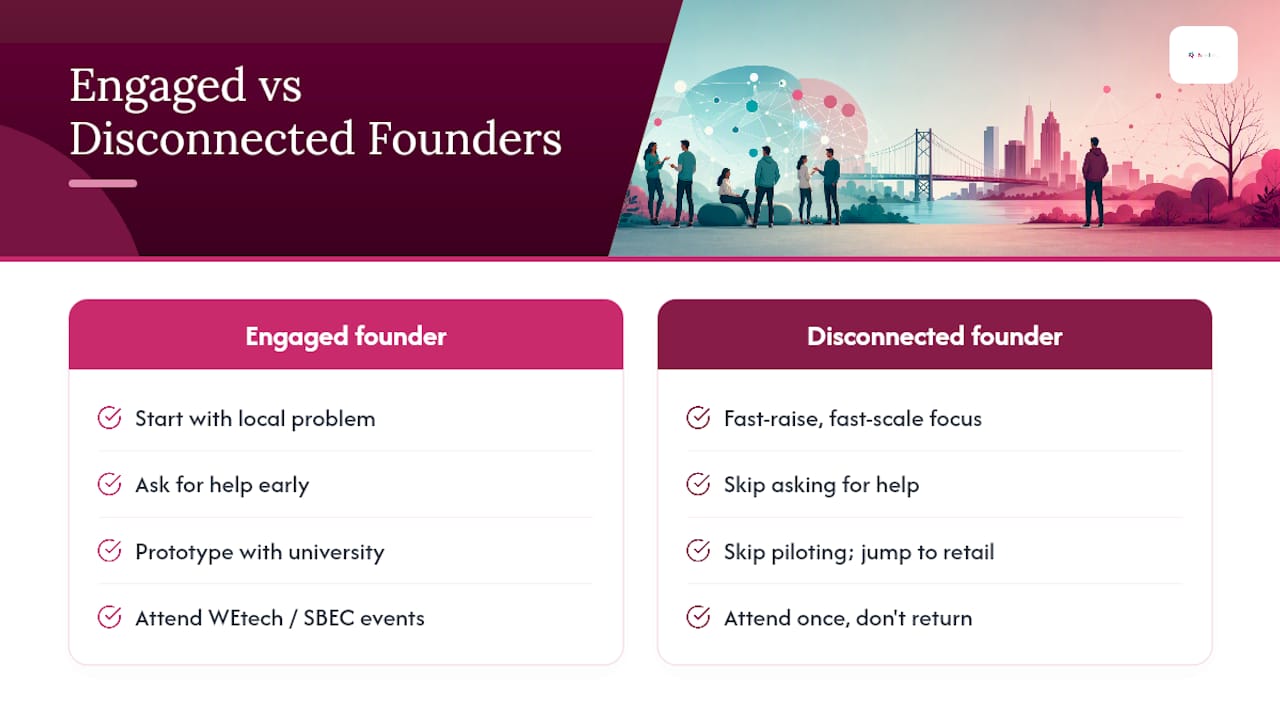
Windsor's founder stories rarely start with venture funding. They start with a specific local problem and a willingness to ask for help early. A manufacturing-tech founder who spent a year refining a prototype with University of Windsor engineering students before ever pitching an investor is a far more typical path here than the fast-raise, fast-scale story you read about in tech media.
What separates founders who gain traction from those who stall usually isn't the idea. It's whether they treated the local ecosystem as a resource instead of a formality. The founders who show up at WEtech events, take SBEC's training seriously, and actually follow up after an introduction tend to get a second and third conversation. The ones who attend once and never resurface don't.
This pattern holds across sectors. A food-tech founder who piloted a product through a university food science connection had a fundamentally different experience than someone who tried to skip straight to retail shelf space. Same for a founder building diagnostic hardware who used WEtech's prototyping pathway to de-risk the technical side before approaching manufacturers. Newcomers to the Windsor startup scene should expect the same rule to apply to them: the relationships compound, but only if you keep showing up and closing the loop on every introduction someone gives you.
Finding your niche: tech, manufacturing, and health startup groups
Windsor's startup activity splits into a few identifiable clusters, and knowing which one you belong to changes who you should be talking to.
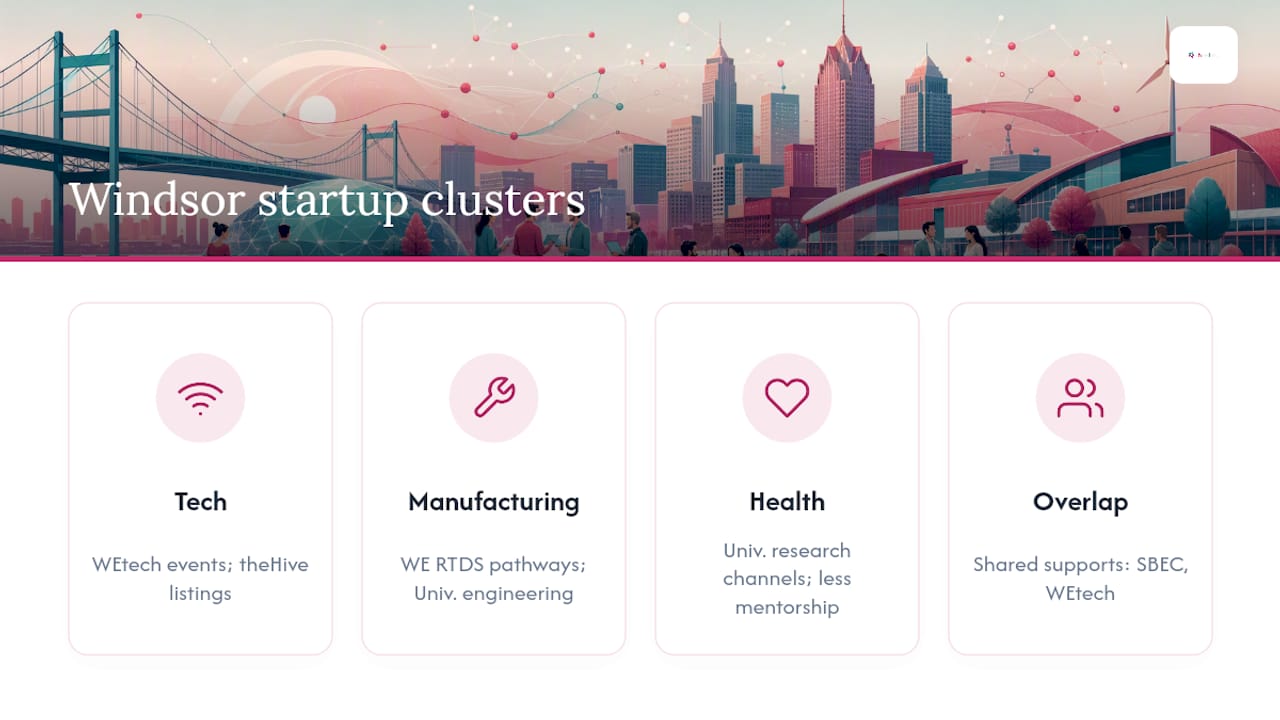
Tech and software founders gravitate toward WEtech Alliance's broader programming and events, plus informal meetups often surfaced through community listings on theHive Windsor. This group tends to be smaller and more scattered than in bigger tech hubs, which actually makes individual relationships more valuable.
Manufacturing and mobility is Windsor's deepest bench, given the region's automotive history. Founders here benefit most from WE RTDS pathways and direct University of Windsor engineering partnerships. If you're building anything involving hardware, supply chains, or industrial processes, this is your community, and it's the most organized one in the region.
Health and life sciences startups are a smaller, emerging group, often connecting through University of Windsor research channels rather than a dedicated health accelerator. Founders in this space should expect more academic collaboration and less pure business mentorship, at least in the earliest stages.
None of these groups are walled off from each other. A manufacturing founder might still find useful mentorship through SBEC's general training, and a health-tech founder might tap WEtech for prototyping help regardless of sector focus. The clusters describe where you'll find your most relevant peers, not a strict lane you're stuck in.
Online and hybrid options when you can't make it in person
Not every founder can attend a Tuesday evening mixer, and Windsor's community has adapted around that reality. WEtech Alliance and SBEC both run virtual training sessions and webinars alongside their in-person programming, which matters if you're balancing a day job or caring for family while building something on the side.
TheHive Windsor's listing and event platform functions as a hybrid layer on top of all of this. You can browse upcoming events, discover other founders and freelancers, and build visibility for your own venture without needing to be in the same room as everyone else first. That matters most in the earliest stage, when showing up to the wrong event costs you an evening you didn't have to spare.
The practical approach is to treat online channels as a filter, not a replacement. Use newsletters, virtual sessions, and community listings to figure out which in-person events and which specific people are worth the drive. Then show up in person for the relationships that actually matter, like a pilot partner conversation or a faculty meeting. Founders who try to build an entire network purely online in a region this size tend to hit a ceiling fast. The city isn't big enough to make that scalable, but it's small enough that the in-person version works remarkably well once you start.
How to prioritize your time by founder stage
Hobbyist-stage founders should chase visibility and feedback, not funding. MVP-stage founders need pilot partners and prototyping access more than they need advice. Once you're pre-commercial, funding and export support from Invest WindsorEssex matter more. Seek mentorship early and often; save paid consulting for specific, narrow problems. Expect real traction to take a full 90-day cycle, not a single event.
— randy
Get discovered without spending on ads
Everything covered here, the events, the introductions, the programs, works better when other founders and customers can actually find you. TheHive Windsor is built for exactly that: a Windsor-Essex discovery platform where your visibility comes from community reviews and engagement, not how much you spend on advertising. Explore the listing and event features to see how event listings, networking tools for freelancers and founders, and referral rewards work together, then create your own free business listing to start showing up in local searches this week. If you're weighing outside funding as part of your 90-day plan, Lending Gurus is worth a look for straightforward small business loan guidance. Get listed, get found, and let the Windsor-Essex community do some of the networking for you.
Sources
- Industry partnerships | University of Windsor
- Regional business support solutions | City of Windsor
- Small Business & Entrepreneurship Centre