

Boutique business visibility is defined as the combined reach a shop holds across local search results, social media feeds, and physical foot traffic channels. How boutique businesses gain visibility determines whether a shop fills its fitting rooms or watches customers walk past to a chain store down the street. The most effective path combines local SEO, social media storytelling, and community presence. Boutiques that execute all three consistently attract more customers without relying on expensive ad budgets to stay competitive.
How boutique businesses gain visibility through local SEO
Local SEO is the single highest-return visibility channel for boutiques. 60–75% of local boutique searches lead to a physical store visit within 48 hours, with 28% resulting in a purchase. That means a shopper who finds your boutique on a local search is far more likely to walk through your door than someone who sees a paid ad.
The foundation of local SEO is a verified and fully optimized Google Business Profile. Boutiques that rank in the top-3 local pack do so by collecting 60 or more five-star reviews that include occasion-specific keywords, and by keeping their name, address, and phone number consistent across 15–20 directories. That consistency signals trust to Google's algorithm.
Occasion-specific review keywords are a tactic most boutique owners overlook entirely. Reviews that mention phrases like "mother of the bride dress" or "date night outfit" double to quadruple revenue impact compared to generic praise. Post-purchase text automation makes collecting these reviews repeatable without adding manual work.
The results of this approach are concrete. Boutiques executing this local SEO strategy see:
- 80–200 new in-store visitors monthly from local search alone
- 45–60% of those visitors converting at an average ticket of $80–$180
- Measurable ranking improvements within 60–90 days of consistent optimization
- Stronger authority in neighborhood-specific search queries over time
Pro Tip: Set up a post-purchase text message that fires automatically after a sale. Include a direct link to your Google review page and a prompt like "Tell us what brought you in today." Occasion-specific language in reviews is the fastest way to rank for high-intent local searches.
Does social media content actually drive foot traffic for boutiques?
Social media content drives foot traffic when it is consistent, specific, and built around a recognizable brand voice. 87% of fashion shoppers begin their buying process with online research, and video content earns 30–40% higher engagement than static images. A boutique that shows up in that research phase with compelling video content has a real advantage.

The posting frequency that produces results is 6–8 posts per week across Instagram, TikTok, and email combined. That volume reaches 4,000–15,000 local residents consistently. Most boutique owners find that number intimidating, but AI-powered content tools can repurpose existing photos and short clips into fresh posts without requiring daily production effort.
Content themes that perform well for boutiques include:
- Styled outfit posts showing complete looks with local context (a Windsor coffee shop, a local event venue)
- Instagram Reels and TikTok videos featuring try-on sessions, behind-the-scenes buying trips, and new arrivals
- Stories with polls, "this or that" styling questions, and limited-time offers to drive urgency
- Email newsletters with curated picks tied to upcoming local events or seasons
Brand identity is what separates a boutique's social presence from a generic retail feed. A curated brand voice and consistent visual style turn casual scrollers into loyal customers. Pick a color palette, a tone, and a content style, then hold to it across every platform.
Pro Tip: Batch-create content one morning per week. Film 4–6 short clips, write captions for all of them, and schedule everything using a social media scheduling tool. This protects your time while keeping your posting frequency high enough to stay visible.
Why community involvement builds visibility that paid ads cannot buy
Physical presence in a community creates the kind of trust that no digital ad can replicate. Storefront clarity, lighting, and inviting design influence walk-in behavior more than discounts do for repeat visits. Your sidewalk is your first marketing channel, and most boutique owners underinvest in it.
Community embeddedness produces steady foot traffic because familiarity drives loyalty. Boutiques that participate in neighborhood events, sponsor local markets, and show up at community gatherings become part of the fabric of their area. That familiarity compounds over time in ways that a one-week ad campaign never will.
A structured approach to community visibility includes:
- Host in-store events tied to local occasions: styling nights, seasonal trunk shows, or charity fundraisers with neighborhood organizations.
- Partner with complementary local businesses like salons, florists, or coffee shops for cross-promotion and shared audiences.
- Launch a brand ambassador program with 5–10 real customers who already love your store and post authentically about it.
- Encourage user-generated content by creating an in-store photo moment, a branded hashtag, and a small incentive for customers who tag you.
- Track repeat visit rates and ask loyal customers directly how they heard about you to identify which community channels are working.
Authentic ambassador programs focused on engagement rather than sheer follower count deliver better trust and ROI than large-scale advertising. A local micro-influencer with 2,000 engaged Windsor followers who genuinely shops your store is worth more than a sponsored post from someone with 50,000 followers who has never been inside.
Pro Tip: Give your brand ambassadors a monthly "first look" at new arrivals before anyone else. That exclusivity motivates them to post organically, and organic posts from real customers carry far more credibility than anything you produce yourself.
When should boutiques invest in paid advertising?
Paid advertising works best as an amplifier, not a foundation. Early paid Meta ads yield poor returns until a boutique reaches approximately 800 active customers and has produced 60 or more styled videos. Spending on ads before those thresholds wastes budget on audiences that have no reason to trust the brand yet.
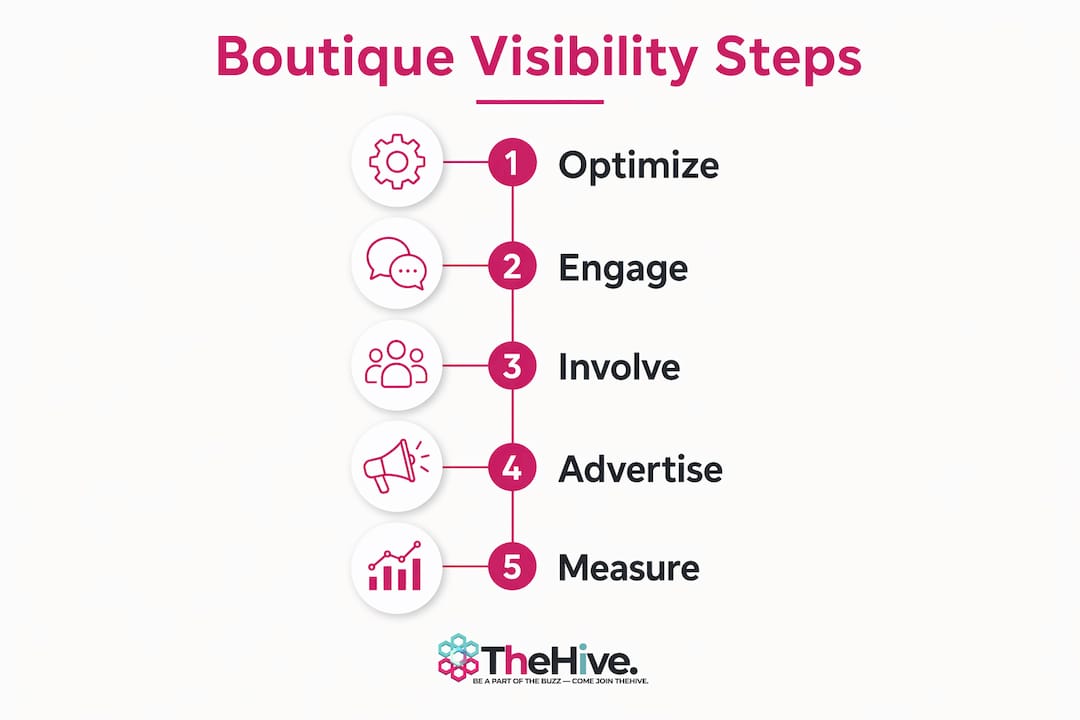
The correct sequence for boutique visibility investment is:
- Phase 1: Build local SEO, collect reviews, and establish a Google Business Profile
- Phase 2: Grow social media content volume and email list through organic posting
- Phase 3: Embed in the community through events, partnerships, and ambassador programs
- Phase 4: Add paid campaigns to retarget warm audiences and amplify proven content
Paid campaigns perform best when they retarget people who have already engaged with your organic content or visited your website. Running cold-audience ads before building that warm pool is the most common and costly mistake boutique owners make.
Pro Tip: Before spending a dollar on paid ads, check whether your best-performing organic posts have reached at least 1,000 local accounts. If they have not, put that budget into local SEO and community events instead. The organic foundation pays dividends long after the ad spend stops.
How do you measure visibility growth for a boutique?
Visibility growth is measured through a combination of foot traffic counts, local search rankings, social media engagement rates, and review quality. Each metric tells a different part of the story, and tracking all four gives boutique owners a complete picture of what is working.
Google Business Profile analytics show how many people found your listing through search, how many requested directions, and how many called directly. These numbers update monthly and reflect the direct impact of your local SEO work. Social media insights on Instagram and TikTok show reach, profile visits, and follower growth by location, which confirms whether your content is reaching the right geographic audience.
Key metrics to track monthly:
- Google Business Profile views and direction requests to measure local search visibility
- Review count and average rating to track reputation momentum
- Social media reach by location to confirm local audience growth
- Email list growth rate as a proxy for audience trust and loyalty
- In-store foot traffic counted weekly, compared against the same period in the prior year
A content calendar prevents the most common visibility killer: inconsistency. Plan posts, review requests, and community events at least four weeks ahead. Visibility compounds when the effort is steady. It collapses when owners go quiet for two or three weeks because operations got busy.
What I've learned about boutique visibility after watching dozens of local shops
The boutiques that grow fastest are not the ones with the biggest budgets. They are the ones that show up consistently, month after month, in search results, on social feeds, and at community events. Patience is the most underrated ingredient in local visibility work.
I have watched boutique owners pour money into paid ads in their first three months and wonder why the results were flat. The answer is almost always the same: the organic foundation was not there yet. No one knew the brand. The review count was low. The social feed was thin. Paid ads cannot fix any of those problems. They only amplify what already exists.
The physical and digital experiences need to reinforce each other. A stunning storefront with a weak Instagram presence loses customers who discover you online and cannot confirm you are worth visiting. A great Instagram feed attached to a poorly lit, cluttered storefront loses customers the moment they arrive. Both sides of the experience matter equally.
My honest advice: spend your first six months building local SEO, posting consistently on social media, and showing up in your neighborhood. Do not touch paid ads until your Google reviews are strong, your content library is deep, and your community knows your name. The visibility you build that way lasts. The visibility you buy disappears the moment the budget runs out.
— randy
Thehivewindsor: local discovery built for Windsor-Essex boutiques
Windsor-Essex boutiques deserve a discovery platform that rewards quality, not ad spend. Thehivewindsor is a local search and discovery platform that ranks businesses based on reviews and community engagement rather than who pays the most for placement.
Whether you are a boutique that has been open for a week or forty years, Thehivewindsor puts you in front of local shoppers who are actively looking for what you sell. The algorithm favors businesses that earn genuine community love, which means your investment in reviews, relationships, and reputation directly improves your ranking. List your boutique on Thehivewindsor and start showing up where Windsor-Essex shoppers are already looking. See how the platform works and find out why local businesses choose community-driven discovery over paid placement.
Key takeaways
Boutique visibility grows fastest when local SEO, consistent social media content, and genuine community presence work together as a system rather than separate tactics.
| Point | Details |
|---|---|
| Local SEO drives real revenue | 60–75% of local boutique searches lead to a store visit within 48 hours. |
| Occasion-specific reviews multiply impact | Reviews mentioning events like "date night" or "mother of the bride" double to quadruple SEO and sales results. |
| Consistent posting reaches thousands | Publishing 6–8 posts per week reaches 4,000–15,000 local residents and drives foot traffic. |
| Paid ads require an organic foundation | Boutiques need roughly 800 active customers and 60+ styled videos before paid Meta ads deliver real ROI. |
| Community presence builds lasting loyalty | Storefront experience, local events, and authentic ambassador programs create trust that digital ads cannot replicate. |
FAQ
How do boutique businesses gain visibility without paid ads?
Boutiques gain visibility without paid ads through local SEO, consistent social media posting, and community involvement. These three channels compound over time and produce lasting results that stop when ad spend stops.
How many social media posts per week does a boutique need?
Publishing 6–8 posts per week across Instagram, TikTok, and email reaches 4,000–15,000 local residents consistently. AI-powered content tools help boutique owners maintain that frequency without sacrificing time on operations.
What makes a Google review more valuable for a boutique?
Reviews that include occasion-specific keywords like "anniversary dinner dress" or "mother of the bride" perform significantly better in local search rankings than generic praise. Automated post-purchase text messages make collecting these reviews repeatable.
When should a boutique start running paid ads?
Paid Meta ads deliver poor returns until a boutique has approximately 800 active customers and 60 or more styled videos in its content library. Building local SEO and organic social presence first creates the warm audience that paid ads need to perform.
How does Thehivewindsor help boutiques get discovered locally?
Thehivewindsor ranks local businesses based on reviews and community engagement rather than ad spend. Boutiques that invest in genuine customer relationships and reputation building rank higher on the platform without paying for placement.