

Digital local discovery is what happens when a nearby customer finds your business through a search, map, app, or AI recommendation before they already know your name. The single most important first step: claim and fully complete your Google Business Profile, then confirm your name, address, and phone number match exactly across every directory listing you own.
Discovery search is fundamentally different from recovery search. Recovery is someone typing your exact business name because they already know you. Discovery is a stranger asking "best coffee near Walkerville" and your business appearing in the answer. That second scenario is where most new customers come from, and it is the one most Windsor-Essex businesses under-invest in.
- Claim and verify your Google Business Profile, Apple Maps Connect, and Bing Places for Business listings.
- Confirm NAP (name, address, phone) is identical on every platform: Facebook, Nextdoor, local directories.
- Add real photos, accurate hours, and service categories to each profile.
- Collect and respond to customer reviews consistently.
Pro Tip: AI is becoming the operating layer for local discovery, according to Localogy's George Thalos. Write short, direct answers to common customer questions on your website and listings so AI engines can quote your business with confidence, as Adam Heitzman at Search Engine Land explains in his guidance on conversation-ready content.
Key Takeaways
Digital local discovery requires consistent signals, conversation-ready content, and active community engagement to earn recommendations from both human neighbors and AI systems.
| Point | Details |
|---|---|
| Claim every listing | Complete Google Business Profile, Apple Maps, and Bing Places with consistent NAP before anything else. |
| Write for AI citation | Answer real customer questions directly in your profile and website so AI engines can quote you. |
| Close the offline loop | Convert every flyer, event, and sponsorship into a digital signal with QR codes, posts, and review prompts. |
| Fix NAP inconsistencies first | Mismatched business names across platforms undermine every other local SEO technique you apply. |
| Thehivewindsor | Windsor-Essex's community-review-ranked platform gives local businesses ad-free discovery visibility. |
Table of Contents
- How offline marketing connects to your digital discovery footprint
- Common mistakes Windsor-Essex businesses make in local discovery
- Why AI changes everything about how locals find you
- Thehivewindsor gives Windsor-Essex businesses a discovery edge without ad spend
- Sources
How offline marketing connects to your digital discovery footprint
Every flyer, event sponsorship, or sidewalk sign you run in Windsor-Essex can feed your digital visibility, but only if you close the loop. When you sponsor a local event, post about it on your Google Business Profile and Facebook page using the same location language. When a customer mentions you to a neighbor, that word-of-mouth becomes a digital signal the moment they leave a Google or Nextdoor review.
QR codes on printed materials that land on a page with your address, hours, and a review prompt do double duty: they convert offline attention into the structured, location-confirmed signals that local search ranking algorithms actually measure. The discovery layer connecting consumers to nearby businesses at the moment of purchase intent requires real-time signals, community reviews, and accurate catalogs. Offline activity that never gets documented online simply disappears from that layer.
Seasonal businesses and event organizers in Windsor-Essex have a specific opportunity here. A pop-up at the Windsor Farmers' Market that posts its dates, location, and photos to its GBP listing and Thehivewindsor profile gets found by people searching that weekend. One that only puts up a Facebook post reaches only its existing followers.
Common mistakes Windsor-Essex businesses make in local discovery
The most damaging mistake is inconsistent NAP data. A business listed as "Smith's Bakery" on Google but "Smiths Bakery" on Yelp and "Smith Bakery Ltd." on Facebook sends conflicting signals to every algorithm that tries to verify it. Fix this before anything else.
The second mistake is treating a Google Business Profile as a one-time setup. Profiles with recent posts, updated photos, and answered reviews consistently outperform static ones. Businesses that boost local visibility without paid ads do it through ongoing engagement, not a single optimization session.
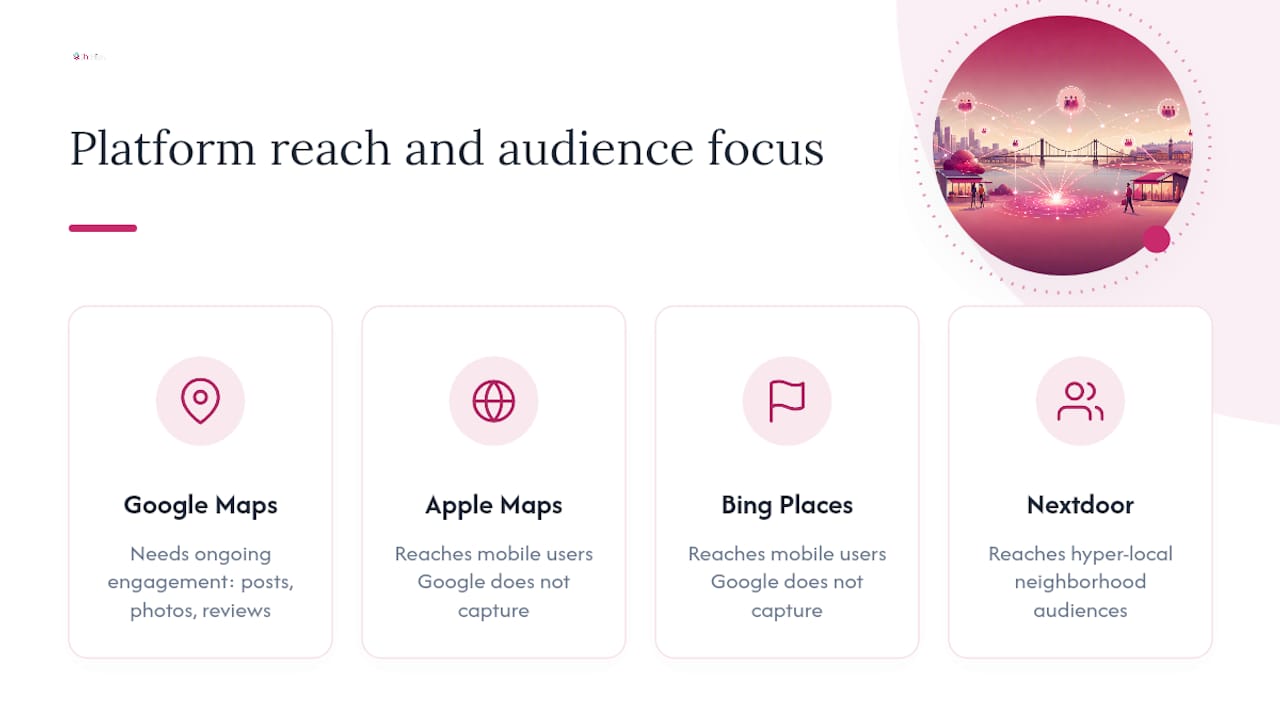
A third pitfall: ignoring secondary platforms. Apple Maps and Bing Places together reach a meaningful share of mobile users that Google Maps does not capture. Nextdoor reaches hyper-local neighborhood audiences that no national platform replicates. Skipping them leaves gaps in your discovery footprint that competitors will fill.
Finally, keyword stuffing your business description does not help. AI-driven discovery systems prefer structured, quotable facts: your hours, your specialties, what problem you solve. Write for a person asking a direct question, not for a crawler counting words.
Why AI changes everything about how locals find you
The conventional wisdom on local SEO has been: rank for keywords, get in the local pack, done. That model is not wrong, but it is incomplete. AI assistants and generative search results now answer local queries directly, pulling from businesses whose profiles and content are structured enough to be quoted with confidence.
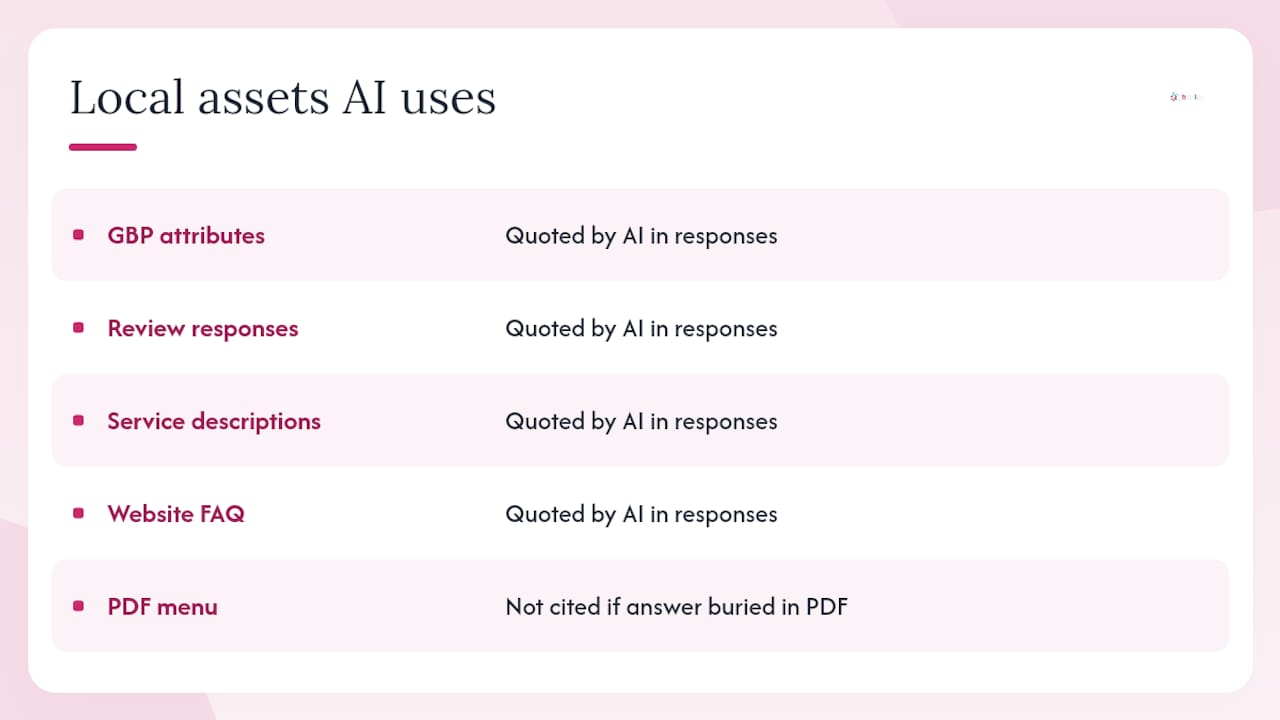
George Thalos at Localogy frames this precisely: organizations that align their operations to AI will be recommended by AI systems at the moment of purchase intent. That means your GBP attributes, your review responses, your service descriptions, and your website FAQ are no longer just SEO assets. They are the raw material AI uses to decide whether to recommend you or your competitor.
For Windsor-Essex businesses, this shift is an opening. Most local competitors have not yet treated discovery as an operational discipline. A restaurant that answers "do you have gluten-free options?" directly on its GBP profile and website will get cited in AI responses. One that buries the answer in a PDF menu will not.
Thehivewindsor operates as a local platform example of this principle. Its community-review-driven ranking algorithm surfaces businesses based on real engagement signals, not ad spend, which mirrors exactly how AI systems weight authentic first-party data over paid placement.
Thehivewindsor gives Windsor-Essex businesses a discovery edge without ad spend
Windsor-Essex businesses that want visibility without paying for every click have a direct path: list your business on Thehivewindsor, the local discovery platform built specifically for this region.
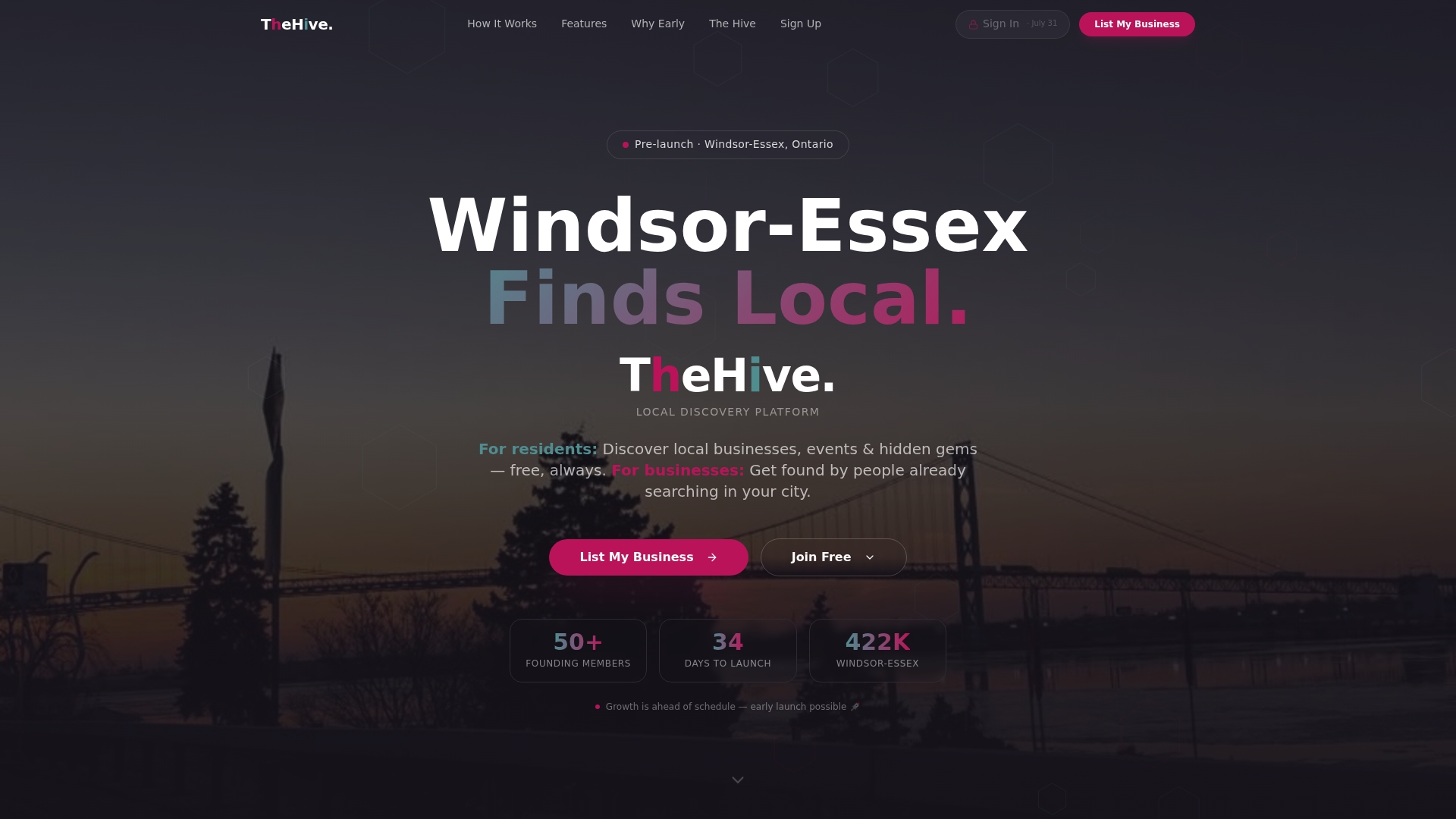
Thehivewindsor ranks businesses by community reviews and real engagement, not by who pays the most. The platform combines business listings, map-based zone search, event listings, referral rewards, and networking tools for freelancers and creators in one place. Residents use it free; businesses access enhanced visibility and promotional tools through a membership subscription. Advanced features like event promotion and priority placement require a paid plan, which is worth knowing upfront.
The result: a Windsor-Essex business that earns strong community reviews on Thehivewindsor builds the kind of authentic, location-confirmed signal that both local residents and AI discovery systems trust. See the full feature set or learn about the mission before you sign up.
Sources
For builders and strategists who want to go deeper:
- GEO x local SEO: What it means for the future of discovery - Search Engine Land
- Local search (Internet) - Wikipedia
- A Practical Guide to Digital Marketing for Local Businesses - Digital Advertising Direct
- The Discovery Layer — Definition & Meaning | Glymp
Google Maps Platform APIs at a glance: